<?xml version="1.0" encoding="utf-8"?>
<feed xmlns="http://www.w3.org/2005/Atom">
    <title>NYC Art</title>
    <link rel="alternate" type="text/html" href="http://www.crywalt.com/blog/" />
    <link rel="self" type="application/atom+xml" href="http://www.crywalt.com/blog/atom.xml" />
    <id>tag:www.crywalt.com,2009-05-12:/blog//1</id>
    <updated>2010-02-04T00:14:31Z</updated>
    
    <generator uri="http://www.sixapart.com/movabletype/">Movable Type Pro 4.25</generator>

<entry>
    <title>Not Forever, Not For Now</title>
    <link rel="alternate" type="text/html" href="http://www.crywalt.com/blog/2010/02/not-forever-not-for-now.html" />
    <id>tag:www.crywalt.com,2010:/blog//1.233</id>

    <published>2010-02-04T00:12:19Z</published>
    <updated>2010-02-04T00:14:31Z</updated>

    <summary><![CDATA[ Fran&ccedil;ois Lemoyne, Time Saving Truth from Falsehood and Envy, oil on canvas, 149x113.5cm (from The Wallace Collection) In case you heard a loud POOF echoing around the art world recently, that was the sudden deflation and disappearance of the...]]></summary>
    <author>
        <name>Chris Rywalt</name>
        
    </author>
    
    <category term="francescobonami" label="Francesco Bonami" scheme="http://www.sixapart.com/ns/types#tag" />
    <category term="garycarrionmurayari" label="Gary Carrion-Murayari" scheme="http://www.sixapart.com/ns/types#tag" />
    <category term="thewhitneybiennial" label="the Whitney Biennial" scheme="http://www.sixapart.com/ns/types#tag" />
    
    <content type="html" xml:lang="en" xml:base="http://www.crywalt.com/blog/">
        <![CDATA[<base href="http://www.crywalt.com/">
<div class="dragme">
<p><img src="/blog/images/20100203/francois_le_moyne.jpg" alt="Francois Lemoyne, Time Saving Truth from Falsehood and Envy, oil on canvas, 149x113.5cm" />
<p>Fran&ccedil;ois Lemoyne, <i>Time Saving Truth from Falsehood and Envy</i>, oil on canvas, 149x113.5cm (from <a href="http://www.wallacecollection.org/collections/gallery/artwork/191">The Wallace Collection</a>)
</div>
<p>
In case you heard a loud POOF echoing around the art world recently, that was the sudden deflation and disappearance of the fa&ccedil;ade of museum curatorial omniscience.  In short, someone just admitted they don't know what they're doing.
</p>
<p>
As <a href="http://www.artfagcity.com/2010/02/03/gearing-up-for-the-biennial-at-the-whitney/">reported over at Art Fag City</a> (for once I'm not picking on Paddy!):
</p>
<p class="quote">
The new fifth floor exhibition [at the Whitney Biennial] "Collecting The Biennial" showcases work collected by the museum from the biennials over the years....  [It] provides a good starting point for the biennial discussion, highlighting both good and bad work. "It shows how taste changes," <a href="http://www.artinfo.com/news/story/33439/in-a-sign-of-the-times-whitney-biennial-shrinks/">Francesco Bonami</a> explained while gesturing to a gaudy Julian Schnabel painting he says they thought was "forever." "It was not," he concluded succinctly.
</p>
<p>
Holy crap, I think Frankie just admitted that those clothes the Emperor was wearing a few years back, they might not have been so nice.  Now if only he and <a href="http://www.artinamericamagazine.com/profiles/gary-carrion-murayari/">Gary Carrion-Murayari</a> could generalize this and realize that what they're choosing <i>now</i> is also crap, things might start improving at the Whitney.
</p>
]]>
        
    </content>
</entry>

<entry>
    <title>Even More Recent Stupidities</title>
    <link rel="alternate" type="text/html" href="http://www.crywalt.com/blog/2010/01/even-more-recent-stupidities.html" />
    <id>tag:www.crywalt.com,2010:/blog//1.231</id>

    <published>2010-01-28T22:13:16Z</published>
    <updated>2010-01-28T22:35:15Z</updated>

    <summary> DUH Things have been quiet. Too quiet. Maybe it&apos;s because they know I&apos;m watching, just waiting for the moment when they write something inane, moronic or just plain stupid, waiting for that moment to pounce! And put them on...</summary>
    <author>
        <name>Chris Rywalt</name>
        
    </author>
    
    <category term="artfagcity" label="Art Fag City" scheme="http://www.sixapart.com/ns/types#tag" />
    <category term="leahtriplett" label="Leah Triplett" scheme="http://www.sixapart.com/ns/types#tag" />
    <category term="michaellandy" label="Michael Landy" scheme="http://www.sixapart.com/ns/types#tag" />
    <category term="tommoody" label="Tom Moody" scheme="http://www.sixapart.com/ns/types#tag" />
    
    <content type="html" xml:lang="en" xml:base="http://www.crywalt.com/blog/">
        <![CDATA[<base href="http://www.crywalt.com/">
<div class="dragme">
<p><img src="/blog/images/20100128/dunce.jpg" alt="DUNCE" />
<p>DUH
</div>
<p>
Things have been quiet.  Too quiet.  Maybe it's because they know I'm watching, just waiting for the moment when they write something inane, moronic or just plain stupid, waiting for that moment to pounce!  And put them on my blog.
</p>
<p>
But probably not.  More likely it's just been quiet.  Very little going on in Dumbbell Land lately, I guess.  Still, I noticed a couple of things.
</p>
<img class="separator" src="/blog/images/DUH-button.jpg">
<p>
She's not even trying any more, is she?  Clearly, when one jabbers out gobbledygook like <a href="http://www.artfagcity.com/2010/01/22/what-is-the-role-of-the-artist/">this</a>, one has given up even making perfunctory stabs at coherence.  Like "the deprofessionalization of art as a form of professionalization" -- yes, he nodded, that makes perfect sense.  And "the idea that unlike earlier times in which only the upper class had time to produce art and text for millions who have no time to view them, now millions of people are creating work for a select few who have no time to view it" -- now incomprehensible in any human language!
</p>
<p>
I can only hope Paddy hopelessly failed to understand or grasp anything said by Mr. Groys, but considering the talk was of interest to both her and <a href="http://www.tommoody.us/archives/2010/01/21/boris-groys-two-sets-of-notes/">Tom Moody</a>, I honestly don't have the stomach to attempt to read much more.
</p>
<img class="separator" src="/blog/images/DUH-button.jpg">
<p>
Keeping Paddy's attempt at writing justified, alas, is the Village Voice, which has listed her blog with 17 other "obsessive, cantankerous, and unstoppable Gotham blogs worth going ape over".  Since the Voice has devolved to basically nothing but cheap newsprint for putting under your overbred apartment-sized idiot dog and online <a href="http://www.villagevoice.com/slideshow/index">softcore porn</a> with a side of <a href="http://www.villagevoice.com/art">limp art criticism</a>, I suppose it shouldn't be shocking when they can't tell their ass from a badly-written blog, but it's still dispiriting.  But the list of ridiculous superlatives is 33% correct:  So far Art Fag City and the rest have been unstoppable.
</p>
<p>
Also, Paddy gave this great quote, which is particularly brilliant when juxtaposed with the preceding item in my list:  "What I've been trying to do here is make things clear for people who don't spend every living moment in the art world, and give them a set of tools with which to look at contemporary art and engage with it."  Uh huh.
</p>
<img class="separator" src="/blog/images/DUH-button.jpg">
<p>
Everyone wants to get on the clearfication of complicatinated artstuff for the masseslikepeople wagon of bandness:  Joining the cacophony is Leah Triplett who <a href="http://www.bigredandshiny.com/cgi-bin/retrieve.pl?section=article&issue=issue124&article=20100211112115666862542#ccc">writes</a>, "Perhaps due to its focus on new media art, Younger Than Jesus, was almost completely devoid in painting of quality. By quality, I mean that which stand the test of time because of their enduring reverberation in one’s mind -- if they are made from ephemeral materials or not."
</p>
<p>
Perhaps, due to its, overuse of commas, this sentence, fails to get its verbs and nouns, to match up.  Children raised by wolves have an easier time putting together working statements than that.  What, pray tell, is a "comically chilling small-scale oil [painting]?"  Is "comically chilling" like "hilariously deadly" or "politely flatulent"?
</p>
<p>
Perhaps all art writing on the Web has been outsourced to some indigenous Amazon rainforest tribe whose only contact with English is a promo t-shirt for the <a href="http://www.amazon.com/Can-Has-Cheezburger-LOLcat-Colleckshun/dp/159240409X"><i>I Can Has Cheezburger</i></a> book.
</p>
<p>
But no, that's just me making up likely-sounding excuses for them.  Fact is, they're just bad writers.
</p>
<img class="separator" src="/blog/images/DUH-button.jpg">
<p>
And finally, proof that when the art world gets it right, it still gets it wrong:  <a href="http://www.metro.co.uk/metrolife/810503-michael-landy-and-the-art-of-destruction">Michael Landy's latest work of art</a> is a giant, transparent bin in which to throw away works of art.  There are a number of problems with this piece, towit:
<ul>
<li>Artists are being <i>asked</i> to submit works of art.  We shouldn't ask artists, we should just throw out their crap.
<li>The artists being asked are certainly worthy of being binned -- Hirst, Emin, and a few other disasters.  Sadly, they've been asked to contribute work <i>they</i> consider failed -- a tall order.  How does one tell a failed Emin from a successful one?  How unwashed the sheets are?
<li>The bin -- with a volume of 600 cubic meters -- is transparent.  This is huge mistake, since clearly no one in their right mind wants to see any of this crap again.
<li>Lastly, the bin cannot be put into itself.
</ul>
</p>
<p>
Perhaps it's too much to ask for, but maybe Damien's next work can be vitrines containing the bodies of the Young British Artists, himself included.
<img class="separator" src="/blog/images/DUH-button.jpg">
]]>
        
    </content>
</entry>

<entry>
    <title>January 7, 2010:   Julian Jackson</title>
    <link rel="alternate" type="text/html" href="http://www.crywalt.com/blog/2010/01/january-7-2010-julian-jackson.html" />
    <id>tag:www.crywalt.com,2010:/blog//1.229</id>

    <published>2010-01-12T23:50:16Z</published>
    <updated>2010-01-13T04:50:29Z</updated>

    <summary> Julian Jackson, Mirage, 2009, oil on wood, 24x42 inches After squeezing my way past the adoring throng at Danese&apos;s building -- which had completely filled the lobby such that I had to push my way out -- I made...</summary>
    <author>
        <name>Chris Rywalt</name>
        
    </author>
    
    <category term="julianjackson" label="Julian Jackson" scheme="http://www.sixapart.com/ns/types#tag" />
    
    <content type="html" xml:lang="en" xml:base="http://www.crywalt.com/blog/">
        <![CDATA[<base href="http://www.crywalt.com/">
<div class="dragme">
<p><img src="/blog/images/20100107/julian_jackson.jpg" alt="Julian Jackson, Mirage, 2009, oil on wood, 24x42 inches" />
<p>Julian Jackson, <i>Mirage</i>, 2009, oil on wood, 24x42 inches
</div>
<p>
After squeezing my way past the adoring throng at Danese's building -- which had completely filled the lobby such that I had to push my way out -- I made for 20th Street and <a href="http://markelfinearts.com/">Kathryn Markel</a> to see the last show in my evening's plan, <a href="http://www.markelfinearts.com/pressrelease.php?prId=121"><i>Will o' the Wisp</i></a> by <a href="http://www.julianjacksonstudio.com/">Julian Jackson</a>.  I'm not sure now how I caught on to his work, but I saw it somewhere -- probably in one of the regular e-mail messages the gallery sends out.  It looked good and I'd been hoping to see it, so when I heard Julian was having an opening, I put it on my list.  Even so I almost skipped it; I wasn't sure I wanted to walk the extra four blocks down and three back on my way home.  I'm glad I went for it.
</p>
<p>
Julian's work is something like what you'd get from Hans Hofmann if he forgot his glasses at home, or from Josef Albers on a squinty day.  Gauzy overlapping rectangles hang in hazy space in each of his paintings.  Some consist of colors very close in hue, others vary more widely.  The paintings are perfectly flat, nearly showing no evidence of brushwork, and slightly matte.  Julian's colors are mostly strongly saturated.  The hazy edges are effected by a lot of blending back and forth and each painting has something of a direction imparted by these strokes; they don't quite come across as brushy but there's a very subtle hairiness to them.
</p>
<p>
Not one of the works in this show qualifies as a stunner, but altogether they're meditative, quiet.  Mellow.  They cast a soothing aura out into the room.  Each one invites calm inspection.
</p>
<p>
I like the paintings more when Julian expands his palette.  Some of them are nearly monochrome -- they could fit in a couple of other group shows I saw that night -- but I think he's better when he's more adventurous.  <i>Mirage</i>, shown here, has some contrast with the cool blues and warm yellows.  It doesn't fade entirely away when you're not concentrating on it.  The more narrowly defined palettes are in danger of vanishing into the background unless you focus on them.
</p>
<p>
I think the dealer managed to find the exact right number of paintings to show:  Too many more would be repetitive; too many fewer wouldn't have the same impact.  Julian's work is shown in the best possible light here and it looks very good.
</p>
<p>
Leaving the building the elevator opened on a lower floor where another opening party was going on in <a href="http://www.denisebibrofineart.com/">Denise Bibro Fine Art</a>.  I don't know how welcome I am there any more but since the elevator had stopped I thought I'd take a look around.  It turned out I was barely able to get off and once off I couldn't move much and couldn't see any of the art.  That's a crowded opening!  After trying to wiggle my way through a bit I gave up and spent the next ten minutes trying to get back to the elevator and out.  So I'm sorry I didn't see anything there.
</p>
<img class="separator" src="/blog/images/nyc_art_token.png">
<p>
<a href="http://www.crywalt.com/cgi-bin/mt/mt-search.cgi?blog_id=1&tag=2010-01-07">See all the reviews from this date</a> or go to <a href="/blog/2010/01/january-7-2010-works-on-paper-at-danese.html">the previous review from this date</a>.
</p>]]>
        
    </content>
</entry>

<entry>
    <title>January 7, 2010:   Works on Paper at Danese</title>
    <link rel="alternate" type="text/html" href="http://www.crywalt.com/blog/2010/01/january-7-2010-works-on-paper-at-danese.html" />
    <id>tag:www.crywalt.com,2010:/blog//1.228</id>

    <published>2010-01-12T22:08:47Z</published>
    <updated>2010-01-13T04:50:58Z</updated>

    <summary> On to Danese and their really huge Works on Paper show (until February 6, 2010). One way to make sure your gallery is packed for the opening party is to cram as many artists as you can in the...</summary>
    <author>
        <name>Chris Rywalt</name>
        
    </author>
    
    <category term="20100107" label="2010-01-07" scheme="http://www.sixapart.com/ns/types#tag" />
    <category term="andyharper" label="Andy Harper" scheme="http://www.sixapart.com/ns/types#tag" />
    <category term="aprilgornik" label="April Gornik" scheme="http://www.sixapart.com/ns/types#tag" />
    <category term="gerardmosse" label="Gerard Mosse" scheme="http://www.sixapart.com/ns/types#tag" />
    <category term="larrypoons" label="Larry Poons" scheme="http://www.sixapart.com/ns/types#tag" />
    <category term="robertlobe" label="Robert Lobe" scheme="http://www.sixapart.com/ns/types#tag" />
    <category term="sebastiaanbremer" label="Sebastiaan Bremer" scheme="http://www.sixapart.com/ns/types#tag" />
    <category term="sidgarrison" label="Sid Garrison" scheme="http://www.sixapart.com/ns/types#tag" />
    <category term="valeriegiles" label="Valerie Giles" scheme="http://www.sixapart.com/ns/types#tag" />
    
    <content type="html" xml:lang="en" xml:base="http://www.crywalt.com/blog/">
        <![CDATA[<base href="http://www.crywalt.com/">
<p>
On to <a href="http://danese.com/">Danese</a> and their really huge <a href="http://danese.com/Main/Group_Shows/WOP_2009/WOP09_artists.html"><i>Works on Paper</i></a> show (until February 6, 2010).  One way to make sure your gallery is packed for the opening party is to cram as many artists as you can in the same show.  You might, for example, herd 40-odd artists onto the gallery walls, and even stick some more in the little project room off the way.  When all the artists' friends, family members, and hangers-on arrive, they'll clog the elevators so badly the line will run out of the microscopic lobby and into the street.
</p>
<p>
Which is what happened at Danese Thursday night.  Not that I really mean to pick on the gallery too much, because the show is really, really good.  Anything with 40 artists in it has a shot of having at least of couple of things I might like, but this time I didn't see more than a couple of clunkers and most of the work is excellent.
</p>
<p>
There's no way I can go through everything on display, especially since the gallery neglected to list all of the work in the main show on the postcard.  And never mind the project room, which wasn't listed, either.  I didn't bring a pen with me so the best I could do was work my way over to the gallery desk to borrow one to make quick marks next to the artists I liked best.  I highly recommend seeing the show for yourself.  (If you can't see it you can run through the <a href="http://danese.com/Main/Group_Shows/WOP_2009/WOP09_artists.html">Website</a>, which I'm pretty sure lists all the works and artists, including the ones missing from the postcard.)
</p>
<div class="dragme">
<p><img src="/blog/images/20100107/andy_harper.jpg" alt="Andy Harper, Untitled, 2009, oil on paper" />
<p>Andy Harper, <i>Untitled</i>, 2009, oil on paper
</div>
<p>
The first thing that caught my eye was <a href="http://www.andyh.net/">Andy Harper</a>'s small oil painting on paper.  I don't think this was on regular paper, but rather some glossy-coated kind, or maybe even that <a href="http://www.yupousa.com/paper/applications">Yupo</a> stuff.  Maybe Andy just gessoed the paper very smooth.  I say this because he's taken advantage of the apparent detail you can get just by brushing oil paints on a non-absorbent ground -- the wealth of striations, wibbles, wobbles, and shades of opacity that magically appear from smearing oil around.  Looking closely you can see the kind of overgrown garden he's painted here is really an abstraction built up of different brush pressures and twists and turns of the strokes.  It's like Bob Ross on steroids.  Or maybe LSD.  Personally I love the physical qualities of paint and I love to see them played with in this way, so not only did I find the painting striking from a distance -- its contrast of tones and hues makes it explode from the wall -- but also worth looking at up close.
</p>
<div class="dragme">
<p><img src="/blog/images/20100107/sebastiaan_bremer.jpg" alt="Sebastiaan Bremer, Game Piece with Glass and Shell, 2009, inks on gelatin silver print, 19 3/4x19 3/4 inches" />
<p>Sebastiaan Bremer, <i>Game Piece with Glass and Shell</i>, 2009, inks on gelatin silver print, 19 3/4x19 3/4 inches
</div>
<p>
Just to the left of Andy's painting is Sebastiaan Bremer's <i>Game Piece with Glass and Shell</i>.  At first glance it looks like a photogram but the media list says it's inks on a print, so I'm guessing we can say Sebastiaan drew on a photo.  Something like that.  It's a pretty little still life with the velvety blacks really looking nice.
</p>
<div class="dragme">
<p><img src="/blog/images/20100107/april_gornik.jpg" alt="April Gornik, Forest Light, 2009, charcoal on paper, 24x30 inches" />
<p>April Gornik, <i>Forest Light</i>, 2009, charcoal on paper, 24x30 inches
</div>
<p>
After that I worked my way clockwise around the room.  I'm not sure of the exact order except that <a href="http://www.aprilgornik.com/">April Gornik</a>'s <i>Forest Light</i> was near the end of my looping trip, and a what a lovely, lyrical way to end the show for me.  Her work is a large, subtle, radiant charcoal of sunlight through a stand of trees; despite its simple, everyday subject, the drawing itself is transcendent.  Somehow April gets the bare paper to glow between the shadows of the trunks.  I am rarely a fan of landscapes or plain nature -- I like a human figure in the vicinity, usually -- but when it's done this well, I can't help but love it.
</p>
<div class="dragme">
<p><img src="/blog/images/20100107/sid_garrison.jpg" alt="Sid Garrison, May 15, 2009, 2009, colored pencil on paper, 28x28 inches" />
<p>Sid Garrison, <i>May 15, 2009</i>, 2009, colored pencil on paper, 28x28 inches
</div>
<div class="dragme">
<p><img src="/blog/images/20100107/robert_lobe.jpg" alt="Robert Lobe, Mossy Brook 2, 2009, ink on paper, 11x10 inches" />
<p>Robert Lobe, <i>Mossy Brook 2</i>, 2009, ink on paper, 11x10 inches
</div>
<div class="dragme">
<p><img src="/blog/images/20100107/gerard_mosse.jpg" alt="Gerard Mosse, Untitled #1, 2009, oil and graphite on vellum, 23 5/8x17 5/8 inches" />
<p>Gerard Mosse, <i>Untitled #1</i>, 2009, oil and graphite on vellum, 23 5/8x17 5/8 inches
</div>
<div class="dragme">
<p><img src="/blog/images/20100107/larry_poons.jpg" alt="Larry Poons, Untitled, c.1992, monotype, 15x22 1/4 inches" />
<p>Larry Poons, <i>Untitled</i>, c.1992, monotype, 15x22 1/4 inches
</div>
<p>
Nothing else in my walk around the very crowded gallery struck me the way April's or Andy's did, but there are many fine pieces.  <a href="http://www.sidgarrison.com/">Sid Garrison</a> has a pretty blue drawing in colored pencil, where he's worked over the pigments to a waxy sheen, almost like encaustics.  <a href="http://www.robertlobe.com/">Robert Lobe</a> has a nice little ink, abstractish but with the sense of something representative underneath -- it sort of looks as if he painted in only the darkest shades of a scene, but I can't quite make out the full image from the parts.  It's neat, though.  (He seems to have done a <a href="http://www.robertlobe.com/drawing/meadowlands/">series of New Jersey Meadowlands drawings</a>, which I mention since I live right next door to them.)  <a href="http://www.gerardmosse.com/">Gerard Mosse</a>'s painting -- even though it's on vellum and therefore maybe technically a drawing -- has a luminescence which is quite striking, and some of the same oil-on-a-smooth-surface effect as Andy's painting.  And <a href="http://www.artnet.com/awc/larry-poons.html">Larry Poons</a> is represented by a decent, small monotype in the project room.  It's not spectacular, but it's good.
</p>
<div class="dragme">
<p><img src="/blog/images/20100107/valerie_giles.jpg" alt="Valerie Giles, Untitled, 2008, graphite, colored pencil and gouache on tinted paper, 7 3/4x9 3/4 inches" />
<p>Valerie Giles, <i>Untitled</i>, 2008, graphite, colored pencil and gouache on tinted paper, 7 3/4x9 3/4 inches
</div>
<p>
I'm also partial to <a href="http://www.artslant.com/global/artists/show/84640-valerie-giles">Valerie Giles</a>' good-sized drawing.  Her swoops and lines, with their calligraphic changes of thickness, and the grace and power of her drawing remind me of...well, of me.  Her strong, solid lines are layered over a lighter level of shaded curves and the whole thing almost, but not quite, coheres into something recognizable.  Instead it just vibrates there in its jazzy way.
</p>
<p>
As I wrote above, there's nothing really bad in this show.  There were a few pieces I didn't care for, that didn't push my buttons, but overall the quality on display is very high.  For a collection of this many artists that's impressive, especially in Chelsea.  I'm almost surprised anyone could get together 40 contemporary artists without there being a pile of construction debris or a video with slowed down sound or something.  There's hope for us yet.
</p>
<img class="separator" src="/blog/images/nyc_art_token.png">
<p>
<a href="http://www.crywalt.com/cgi-bin/mt/mt-search.cgi?blog_id=1&tag=2010-01-07">See all the reviews from this date</a>, go to <a href="/blog/2010/01/january-7-2010-metamorphoseis.html">the previous review from this date</a>, or go to <a href="/blog/2010/01/january-7-2010-julian-jackson.html">the next review from this date</a>.
</p>]]>
        
    </content>
</entry>

<entry>
    <title>January 7, 2010:   Alessio Delfino</title>
    <link rel="alternate" type="text/html" href="http://www.crywalt.com/blog/2010/01/january-7-2010-metamorphoseis.html" />
    <id>tag:www.crywalt.com,2010:/blog//1.227</id>

    <published>2010-01-12T15:43:41Z</published>
    <updated>2010-01-13T04:51:35Z</updated>

    <summary> Alessio Delfino, Metamorphoseis, 2009 Meanwhile across the hall from McKenzie Fine Art is Kips Gallery. I&apos;ve seen a couple of things there that were okay but I didn&apos;t write them up for one reason or another. Mostly I go...</summary>
    <author>
        <name>Chris Rywalt</name>
        
    </author>
    
    <category term="20100107" label="2010-01-07" scheme="http://www.sixapart.com/ns/types#tag" />
    <category term="alessiodelfino" label="Alessio Delfino" scheme="http://www.sixapart.com/ns/types#tag" />
    
    <content type="html" xml:lang="en" xml:base="http://www.crywalt.com/blog/">
        <![CDATA[<base href="http://www.crywalt.com/">
<div class="dragme">
<p><img src="/blog/images/20100107/alessio_delfino.jpg" alt="Alessio Delfino, Metamorphoseis, 2009" />
<p>Alessio Delfino, <i>Metamorphoseis</i>, 2009
</div>
<p>
Meanwhile across the hall from McKenzie Fine Art is <a href="http://kipsgallery.com/">Kips Gallery</a>.  I've seen a couple of things there that were okay but I didn't write them up for one reason or another.  Mostly I go in because they're directly across the way from Valerie's gallery and if I'm there I might as well.  This time, too, I saw that the show involved nudity, so I figured I could stop in.
</p>
<p>
The show is <a href="http://www.alessiodelfino.com/">Alessio Delfino</a>'s <a href="http://kipsgallery.com/allesio/delfino.html"><i>Metamorphoseis</i></a>.  The gallery verbiage on this is not to be believed -- it's almost a conceptual piece in itself, some kind of dada satire:  "The grandeur of Alessio Delfino’s <i>Metamorphoseis</i> -- a synthesis of photography and video in the purest sense -- comes from a perspective on fashion fused with an acute awareness of both fine art and history....  <i>Metamorphoseis</i> is a work of art that deserves serious attention, not only on the level of being a spectacle (which, in a sense, it is), but also on two other irreconcilable issues, namely connoisseurship and representation."
</p>
<p>
Wowie zowie, sounds just incredible, don't it?  The purest synthesis of photography and video?  Connoisseurship?  Representation?  Bow down before my works, ye mighty, and despair!
</p>
<p>
Or not.  What it actually turns out to be is, as usual, an excuse for a photographer to get women out of their clothes.  Which is fine as long as one is honest about the enterprise.  Alessio talked a number of women into getting naked, being painted gold, and standing in the same pose.  Then he took their photos and printed them out all the same size -- nearly life size -- and put them all in a row on the wall.  On the other wall he's got a <a href="http://www.alessiodelfino.com/video/metamorphoseisVI.mov">video</a> of the women, also all in a row, all morphing into one another via the very cutting edge of 1991 video technology.
</p>
<p>
The excitement in the gallery is palpable.  Oh, wait, no, I meant boredom.  Someone had burned about a metric buttload of incense in the room, too, I guess in an attempt to induce a boudoir atmosphere or something.  Plan failed.
</p>
<p>
Let's quote the verbiage (by Robert C. Morgan) again:  "Delfino has done the research.  In selecting his 'models,' he decided not to go for professionals but to choose everyday ordinary people. In making his selection, he would converse with each woman in order to understand her character."  Funny how, although he supposedly chose ordinary women, all of them ended up being approximately the same size, shape, and ethnicity -- the same approximate size, shape, and ethnicity of anyone on the cover of Vogue or W (or Maxim, for that matter).  Why is it whenever a photographer starts going on about the beauty of Woman and the cultural importance of femininity, they always seem to end up with the same kind of models the fashion industry pushes as sex objects?
</p>
<p>
More verbiage:  "He would then try and compare the women with one of the Athenian goddesses. He aspiration [oh god, sic] was less concerned with expressing erotic qualities than in emphasizing the concept of natural beauty over the mediated notion of instantaneous glamour."  Natural beauty, right.  Which explains why none of the women have body hair and at least two of them have obvious breast implants.  Also, apparently Athenian goddesses over 35 need not apply.
</p>
<p>
The show, in case my tone hasn't made it clear, is a complete waste of time, and that's even though it only takes about eight seconds to take in the whole thing.  Investing that eight seconds in almost any other activity -- including staring off into space in the empty hallway -- would be wiser.
</p>
<img class="separator" src="/blog/images/nyc_art_token.png">
<p>
<a href="http://www.crywalt.com/cgi-bin/mt/mt-search.cgi?blog_id=1&tag=2010-01-07">See all the reviews from this date</a>, go to <a href="/blog/2010/01/january-7-2010-mostly-monochrome.html">the previous review from this date</a>, or go to <a href="/blog/2010/01/january-7-2010-works-on-paper-at-danese.html">the next review from this date</a>.
</p>]]>
        
    </content>
</entry>

<entry>
    <title>January 7, 2010:   Mostly Monochrome at McKenzie Fine Art</title>
    <link rel="alternate" type="text/html" href="http://www.crywalt.com/blog/2010/01/january-7-2010-mostly-monochrome.html" />
    <id>tag:www.crywalt.com,2010:/blog//1.226</id>

    <published>2010-01-12T01:52:39Z</published>
    <updated>2010-01-13T04:52:30Z</updated>

    <summary> James Lecce, Meltaway, 2008, acrylic polymer emulsion on panel, 42x24 inches After working my way through Piri&apos;s suggestions it was time for my own. I started where I often start, at McKenzie Fine Art, where Valerie McKenzie had put...</summary>
    <author>
        <name>Chris Rywalt</name>
        
    </author>
    
    <category term="20100107" label="2010-01-07" scheme="http://www.sixapart.com/ns/types#tag" />
    <category term="billthompson" label="Bill Thompson" scheme="http://www.sixapart.com/ns/types#tag" />
    <category term="jameslecce" label="James Lecce" scheme="http://www.sixapart.com/ns/types#tag" />
    <category term="karengunderson" label="Karen Gunderson" scheme="http://www.sixapart.com/ns/types#tag" />
    <category term="litrincere" label="Li Trincere" scheme="http://www.sixapart.com/ns/types#tag" />
    <category term="matthewdeleget" label="Matthew Deleget" scheme="http://www.sixapart.com/ns/types#tag" />
    
    <content type="html" xml:lang="en" xml:base="http://www.crywalt.com/blog/">
        <![CDATA[<base href="http://www.crywalt.com/">
<div class="dragme">
<p><img src="/blog/images/20100107/james_lecce.jpg" alt="James Lecce, Meltaway, 2008, acrylic polymer emulsion on panel, 42x24 inches" />
<p>James Lecce, <i>Meltaway</i>, 2008, acrylic polymer emulsion on panel, 42x24 inches
</div>
<p>
After working my way through Piri's suggestions it was time for my own.  I started where I often start, at <a href="http://mckenziefineart.com/">McKenzie Fine Art</a>, where Valerie McKenzie had put together the group show <a href="http://mckenziefineart.com/exhib/monochrome2010exhb.html"><i>Mostly Monochrome</i></a> (until February 6, 2010).  Unlike <i>Winter White</i>, this show involves more than one color, but only one color per artwork.  Approximately.
</p>
<p>
It's not the strongest group show Valerie's put together.  There are some good pieces here, but some I'd just as soon skip.  On the good side there's <a href="http://www.mckenziefineart.com/artists/lecce/lecce.html">James Lecce</a>, whose show in 2006 <a href="/blog/2006/03/lynn-jadamec-james-lecce-stephen-westfall-judith-linhares-ellis-gallagher.html">I really liked</a>.  I also saw his next show, last year I think it was, and I liked that also, but I guess I forgot to write it up.  His piece in this show, <i>Meltaway</i>, may be one of the ones from his last show.  He's been using metallic paints, glittery stuff which doesn't reproduce too exactly, but which looks great.  I still love his swirls of color and the way they flow across the surface.  The varying tones blend optically while never blending physically.  And you can't see it in the JPEG but there's a wealth of striations in each seemingly homogeneous layer which give the whole painting a vibrancy only enhanced by the shimmering metal flake.  As far as I'm concerned, James can keep doing these forever.
</p>
<div class="dragme">
<p><img src="/blog/images/20100107/matthew_deleget.jpg" alt="Matthew Deleget, They Don't Love You, Like I Love You, 2009, silver monochromes, iridescent silver acrylic paint on 4 panels, hit with a hammer, 16x60 inches" />
<p>Matthew Deleget, <i>They Don't Love You, Like I Love You</i>, 2009, silver monochromes, iridescent silver acrylic paint on 4 panels, hit with a hammer, 16x60 inches
</div>
<p>
On the bad side, on the wall facing James' painting, is <a href="http://matthewdeleget.com/">Matthew Deleget</a>'s <i>They Don't Love You, Like I Love You</i>, which includes "hit with a hammer" in its list of media (to say nothing of the extraneous comma in the title).  That pretty much sums it up:  Four wooden panels, painted silver, and smashed with a hammer until barely more than the cradles are left.  If he'd gone ahead and finished off those we'd all be happier.  Everybody say yeah yeah yeah!
</p>
<div class="dragme">
<p><img src="/blog/images/20100107/bill_thompson.jpg" alt="Bill Thompson, KK2, 2007, acrylic and urethane on polyurethane block, 11 1/4x9x4 inches" />
<p>Bill Thompson, <i>KK2</i>, 2007, acrylic and urethane on polyurethane block, 11 1/4x9x4 inches
</div>
<p>
Aside from James, I rather liked Bill Thompson's two pieces, <i>KK2</i> and <i>KK3</i>.  They struck me as kind of Donald Judd-like, although far more playful than Judd would ever be.  Which is to say very slightly whimsical.  There's not a lot to them but that's part of their charm.  I'm taken in by their simplicity and smoothness, how solid they seem to be hanging there on the wall.
</p>
<div class="dragme">
<p><img src="/blog/images/20100107/karen_gunderson.jpg" alt="Karen Gunderson, Churning Sea, A Moment Later, 2009, oil on board, 24x24 inches" />
<p>Karen Gunderson, <i>Churning Sea, A Moment Later</i>, 2009, oil on board, 24x24 inches
</div>
<p>
I also found myself peering into Karen Gunderson's <i>Churning Sea, A Moment Later</i>.  The JPEG here doesn't even come close to reproducing this accurately -- I have a feeling Valerie's photographer (who I've sometimes seen at work in the gallery) had a conniption over this one.  The painting is entirely black, the waves being made up of brushstrokes.  You can only see them as the light bounces off in different directions.  The photo makes it look as if the painting contains shades of gray, which it does not.  Is it a bit gimmicky?  Yes it is.  Does it work?  Yes it does.
</p>
<div class="dragme">
<p><img src="/blog/images/20100107/li_trincere.jpg" alt="Li Trincere, Montauk 1, 2007-8, acrylic on canvas, 36x36 inches" />
<p>Li Trincere, <i>Montauk 1</i>, 2007-8, acrylic on canvas, 36x36 inches
</div>
<p>
Honorable Mention for Painting Like Ken Noland goes to <a href="http://litrincere.blogspot.com/">Li Trincere</a> for <i>Montauk 1</i>, a shaped canvas, albeit not as aggressively shaped as Noland's, painted with metal flake also, giving it a nice flip-flop character I'm sure Noland also experimented with.  The color Li chose for this one is lovely and jewel-like and the rhombus canvas sets it off nicely.
</p>
<p>
Everything else in the show is better than the "hit with hammer" one but not up to what I've mentioned here.  On balance, worth a visit, as usual.
</p>
<img class="separator" src="/blog/images/nyc_art_token.png">
<p>
<a href="http://www.crywalt.com/cgi-bin/mt/mt-search.cgi?blog_id=1&tag=2010-01-07">See all the reviews from this date</a>, go to <a href="/blog/2010/01/january-7-2010-winter-white-at-tria-gallery.html">the previous review from this date</a>, or go to <a href="/blog/2010/01/january-7-2010-metamorphoseis.html">the next review from this date</a>.
</p>]]>
        
    </content>
</entry>

<entry>
    <title>January 7, 2010:   Winter White at Tria Gallery</title>
    <link rel="alternate" type="text/html" href="http://www.crywalt.com/blog/2010/01/january-7-2010-winter-white-at-tria-gallery.html" />
    <id>tag:www.crywalt.com,2010:/blog//1.230</id>

    <published>2010-01-11T20:09:00Z</published>
    <updated>2010-01-13T04:53:02Z</updated>

    <summary> Piri&apos;s final recommendation to me was a group show of new work at Tria Gallery titled Winter White (until January 21, 2010). I hustled up to 25th Street and made it in before Carol Suchman, one of the gallery...</summary>
    <author>
        <name>Chris Rywalt</name>
        
    </author>
    
    
    <content type="html" xml:lang="en" xml:base="http://www.crywalt.com/blog/">
        <![CDATA[<base href="http://www.crywalt.com/">
<p>
Piri's final recommendation to me was a group show of new work at <a href="http://www.triagallery.net/">Tria Gallery</a> titled <a href="http://www.triagallery.net/PR/2009dec10.pdf"><i>Winter White</i></a> (until January 21, 2010).  I hustled up to 25th Street and made it in before Carol Suchman, one of the gallery principals, could close up shop.
</p>
<p>
I have to admit that the show's genesis puts me on my guard:  The gallery verbiage says "Tria challenged eight artists to come up with their own interpretation of the expression 'winter white.'"  The artificiality of this bothers me for some reason.  On the other hand, sometimes constraints, even artificial ones, can coax better work out of an artist.  I don't know any of the artists in the show so I can't say, but I did like the work.
</p>
<div class="dragme">
<p><img src="/blog/images/20100107/francine_tint.jpg" alt="Francine Tint, dream life of angels, 2009, acrylic on canvas, 30x78 inches" />
<p>Francine Tint, <i>dream life of angels</i>, 2009, acrylic on canvas, 30x78 inches
</div>
<p>
If I absolutely had to choose the best in the show, I might go with <a href="http://www.francinetint.com/">Francine Tint</a>'s painting.  It's a beautiful and subdued Abstract Expressionist piece, all nearly monochrome and warm beige except for a splashy stab of blue.  It's mutely eloquent, the way good Abstract Expressionism can be, without being overwhelming.  The tight range of values holds the whole thing together and the width is just enough to encompass your field of view and hold you there.  It's equal parts restraint and abandon -- close hues slapped on wildly -- and it works.
</p>
<p>
Another candidate for best would be <a href="http://www.serenabocchino.com/">Serena Bocchino</a>'s painting.  Alas, I have no image to share with you since the gallery has so far been unable to get a good photo of it.  It is, after all, white.  You can see from Serena's site the kind of work she does -- a sort of constricted Jackson Pollock drip, more calligraphic, less wild.  Her other work looks to me as if it might be in danger of being too twee, but working white on white cuts her back in a good way.  Not only is her paint more tightly wound than Pollock's, it's shinier, too, lying on the surface like a piece of polished plastic.
</p>
<p>
Carol gave me one of Serena's digital cards, a credit card-sized thing with a flip-out USB plug.  At home I got to plug it in and watch a short video, music by Pat Metheny, which is basically a slideshow of Serena's work, although the introduction is a clip of her painting, canvas out on the floor, dripping away like old Jack.  Only barefoot.  This seems to me like a great way to promote artwork.  It's extremely groovy.
</p>
<div class="dragme">
<p><img src="/blog/images/20100107/michela_martello.jpg" alt="Michela Martello, White, 2009, mixed media on canvas, 27x29 inches" />
<p>Michela Martello, <i>White</i>, 2009, mixed media on canvas, 27x29 inches
</div>
<p>
Close on the heels of those two I'd put <a href="http://www.michelamartello.com/">Michela Martello</a>.  I liked her <i>White</i>, shown here, despite its use of a word.  I'm not a big fan of words in paintings.  That "WHITE" isn't white at all is kind of funny, though, like one of those perception tests you can take online.  The surface of this painting is nicely chunky, very lively, contrasting with the stillness of the subject and the chilliness of the color scheme.
</p>
<div class="dragme">
<p><img src="/blog/images/20100107/andrew_millner.jpg" alt="Andrew Millner, Winter White, 2009, inkjet print, 47x73 inches" />
<p>Andrew Millner, <i>Winter White</i>, 2009, inkjet print, 47x73 inches
</div>
<p>
The rest of the work in the show is good, also.  The only exception for me is the inkjet print submitted by <a href="http://www.andrewmillner.com/">Andrew Millner</a>.  Apparently what Andrew does is work out these digital compositions and then print them.  The result looks decidedly computer generated, like fractal-based wireframe landscapes in the early 1990s.  About the only thing going for it, in fact, is that it fits in perfectly with the latest trend in art as reported by Joanne Mattera, which is <a href="http://joannemattera.blogspot.com/2009/12/fair-and-fair-alike-miami-2009-are-we.html">trees</a>.
</p>
<img class="separator" src="/blog/images/nyc_art_token.png">
<p>
<a href="http://www.crywalt.com/cgi-bin/mt/mt-search.cgi?blog_id=1&tag=2010-01-07">See all the reviews from this date</a>, go to <a href="/blog/2010/01/january-7-2010-helen-frankenthaler.html">the previous review from this date</a>, or go to <a href="/blog/2010/01/january-7-2010-mostly-monochrome.html">the next review from this date</a>.
</p>]]>
        
    </content>
</entry>

<entry>
    <title>January 7, 2010:   Helen Frankenthaler</title>
    <link rel="alternate" type="text/html" href="http://www.crywalt.com/blog/2010/01/january-7-2010-helen-frankenthaler.html" />
    <id>tag:www.crywalt.com,2010:/blog//1.225</id>

    <published>2010-01-11T20:08:16Z</published>
    <updated>2010-01-13T04:53:57Z</updated>

    <summary> Helen Frankenthaler, High Spirits, 1988, acrylic on canvas, 65 3/4x98 3/8 inches Having exhausted myself amidst the crenellations and battlements of uptown I headed downtown to Chelsea to catch Piri&apos;s other two recommendations before the galleries closed and the...</summary>
    <author>
        <name>Chris Rywalt</name>
        
    </author>
    
    <category term="20100107" label="2010-01-07" scheme="http://www.sixapart.com/ns/types#tag" />
    <category term="helenfrankenthaler" label="Helen Frankenthaler" scheme="http://www.sixapart.com/ns/types#tag" />
    
    <content type="html" xml:lang="en" xml:base="http://www.crywalt.com/blog/">
        <![CDATA[<base href="http://www.crywalt.com/">
<div class="dragme">
<p><img src="/blog/images/20100107/helen_frankenthaler.jpg" alt="Helen Frankenthaler, High Spirits, 1988, acrylic on canvas, 65 3/4x98 3/8 inches" />
<p>Helen Frankenthaler, <i>High Spirits</i>, 1988, acrylic on canvas, 65 3/4x98 3/8 inches
</div>
<p>
Having exhausted myself amidst the crenellations and battlements of uptown I headed downtown to Chelsea to catch Piri's other two recommendations before the galleries closed and the openings opened.  I went as directly as possible to <a href="http://www.ameringer-yohe.com/">Ameringer McEnery Yohe</a> (and isn't that a crowd) to see <a href="http://www.ameringer-yohe.com/?ex=31">Helen Frankenthaler</a> (until January 23, 2010).  It does seem a little odd for me to pay this much attention to established older artists, but at least it gives you, my wonderful readers, a chance to see what I think about a wider range of work.
</p>
<p>
I'm no expert on color field painters so I'm not really familiar with Helen Frankenthaler's work.  In the conversational circles I travel it's impossible not to know who she is -- she's one of the few women you hear about from the days of High Modernism -- but her work doesn't get pulled out of storage as often as, say, Jasper Johns or Jackson Pollock.  In fact I'm not sure if I've ever seen one of her paintings.  Maybe if they had one up at MoMA once.  Her breakthrough hit, <a href="http://www.artchive.com/artchive/F/frankenthaler/frankenthaler_mtns.jpg.html"><i>Mountains and Sea</i></a>, is frequently cited as the painting that launched a thousand paintings -- the story is Morris Louis and Ken Noland formulated their color field work after seeing it in New York -- but I don't think I've ever seen it in person.
</p>
<p>
The show at Ameringer is of work thirty years past that breakthrough moment -- all from the 1980s -- and it still finds Helen doing much the same thing:  Staining rectangular canvas with her acrylics.  It seems to be enough, although in these paintings she also blobs on thicker passages, contrasting nicely with the thin washes.
</p>
<p>
As with the Noland show I'd just seen, I didn't feel that any of these were great works of art, but again, compared to work like Richter's, they're masterpieces of probing intelligence.  None of these paintings feels unstudied, hurried, or thoughtless.  Each one expresses a great deal of decision-making, from the color choices to the compositions.  All of Helen's considerable experience with picture-making is evident in each painting.
</p>
<p>
That said, nothing here looks really necessary, either.  Especially not the rather unfortunate three-piece bronze screen, which looks as if it went through a garbage compactor before being left out in the rain for twenty years.  A couple of smaller studies on paper don't help.  This is probably a lesser showing from the artist.
</p>
<p>
Still, a lesser show from Helen Frankenthaler beats the best a lot of contemporary artists can muster.
</p>
<img class="separator" src="/blog/images/nyc_art_token.png">
<p>
<a href="http://www.crywalt.com/cgi-bin/mt/mt-search.cgi?blog_id=1&tag=2010-01-07">See all the reviews from this date</a>, go to <a href="/blog/2010/01/january-7-2010-ken-noland.html">the previous review from this date</a>, or see <a href="/blog/2010/01/january-7-2010-winter-white-at-tria-gallery.html">the next review from this date</a>.
</p>]]>
        
    </content>
</entry>

<entry>
    <title>January 7, 2010:   Ken Noland</title>
    <link rel="alternate" type="text/html" href="http://www.crywalt.com/blog/2010/01/january-7-2010-ken-noland.html" />
    <id>tag:www.crywalt.com,2010:/blog//1.224</id>

    <published>2010-01-11T17:59:58Z</published>
    <updated>2010-01-13T04:54:45Z</updated>

    <summary> I&apos;m going to try something a little different with the shows I saw last Thursday: I&apos;m going to break them out into separate entries. The last slog I wrote up ran very long and having all the shows together...</summary>
    <author>
        <name>Chris Rywalt</name>
        
    </author>
    
    <category term="20100107" label="2010-01-07" scheme="http://www.sixapart.com/ns/types#tag" />
    <category term="kennoland" label="Ken Noland" scheme="http://www.sixapart.com/ns/types#tag" />
    
    <content type="html" xml:lang="en" xml:base="http://www.crywalt.com/blog/">
        <![CDATA[<base href="http://www.crywalt.com/">
<p>
I'm going to try something a little different with the shows I saw last Thursday:  I'm going to break them out into separate entries.  The last slog I wrote up ran very long and having all the shows together like that seemed a bit too much.  What I'm going to do is write up separate entries and have them connected by a tag and also add in links to the next entry in the night.  We'll see how it goes.
</p>
<div class="dragme">
<p><img src="/blog/images/20100107/ken_noland.jpg" alt="Kenneth Noland, Rutilant, 1982, acrylic on canvas, 74.2x25.2 inches" />
<p>Kenneth Noland, <i>Rutilant</i>, 1982, acrylic on canvas, 74.2x25.2 inches
</div>
<p>
I started bright and early in the late afternoon.  The late afternoon isn't bright and early, of course, but it is when you're talking about gallery openings, which traditionally start at six o'clock.  The trick is, if you want to see shows that have already opened and also attend some openings, you have to go in early enough before the galleries close -- traditionally at six o'clock -- while planning your trip to end in Chelsea when the openings have started.  Because you don't want to have to find something to do in Chelsea while you wait for the openings to start.  Aside from art galleries and the 24-hour taxicab car wash there's not much to do.
</p>
<p>
The wonderful <a href="http://piri.home.mindspring.com/">Piri Halasz</a> had recommended I see <a href="http://www.artcyclopedia.com/artists/noland_kenneth.html">Ken Noland</a>'s show at <a href="http://www.artnet.com/gallery/369/leslie-feely-fine-art.html">Leslie Feely</a> uptown (until January 15, 2010).  Ken's been mentioned a lot lately since he just passed away after a career in art spanning five decades, which is a lot to talk about.  His work at Leslie Feely is from a very narrow slice of that -- 1981 and '82 -- but it coincidentally happened to be up, so it was worth going to.
</p>
<p>
I walked along East 68th Street from the subway station at Lexington musing over the buildings lining the sidewalks.  I don't know much about architecture but I'd say most of them date from the early 20th century, great big piles of gray stone for the captains of industry of the day, all huge curving windows and cast iron, polished brass and terracotta decoration.  Most of them have been converted into one-floor apartments or offices, but a few seem as if they might still be single dwellings for the wealthy of today.  As I walked, lost in thought about these lovely old houses, wondering who lives in them now and what the block looked like when they were new, I came upon one of those quintessential New York discontinuities, a modernist steel-framed glass curtain wall.  It knocked me out of my reverie, which was good, because I'd arrived at the gallery.
</p>
<p>
Upstairs I found the gallery somewhat cramped -- the ceilings felt low to me -- and a little more dimly lit than I'd like.  One of Ken's shaped paintings greets you as soon as you step from the elevator; the rest are arranged around the two main spaces of the gallery.  There are twelve on the <a href="http://www.artnet.com/galleries/Exhibitions.asp?gid=369&cid=179198&rta=http://www.artnet.com&source=-1">show's Website</a>.  I thought there might be more in the show itself but maybe not.  I didn't count them.
</p>
<p>
All of the work in this show is from Ken's period of shaped canvases.  Of course he's better known for his targets -- concentric rings of color centered on the canvas -- but he spent many years going in other directions, most of them concentrating on color relationships and minimizing everything else.  These paintings are all what I'd call <i>extremely</i> shaped:  He's bent the canvas around many sharp angles, both obtuse and acute, resulting in a series of tall, narrow paintings with anywhere from six to eight edges.  Each one appears to balance on a point, like a shard of stone in a megalith.  Narrow stripes follow two or more of the edges on a field of solid color.
</p>
<p>
My feeling is that the paintings are too constricted.  I think Ken was trying to channel his sense of color through a bottleneck. In some cases the canvas is even shaped into a narrow isthmus.  Instead of the color giving the impression that it's flowing across the surface to fetch up against the stripes on the sides, it feels like the stripes are lying on top of a small band.  The colors have no room to breathe and thus have no real relation to one another; they don't seem to be in the same space.  Ken is known for his color sense but in these paintings I think it got overwhelmed by the support.
</p>
<p>
For me, the actual shape of the canvases became the focal point.  The shapes are so forced and unnatural, and so tightly bound visually, that they squeeze out any interest in the painting as an abstraction.  I found myself more interested in the flaws of the presentation, something I feel certain Ken didn't want.  Linen canvas always comes with these little knots in parts of the weave where the thread, for whatever reason, is thicker than elsewhere.  These knots stand out in great relief from the otherwise flawlessly flat color.  Also, some of the shapes are so torturous for the canvas -- when you stretch fabric around such tight angles you're attempting to force a flat shape on something that simply can't lie that flat -- waves were left in the surface.  I'm sure these annoyed the hell out of the artist and he did his best to eliminate them -- I can imagine him pulling harder and harder on those canvas pliers -- but I ended up fixating on them instead of the color.
</p>
<p>
I also felt that the color combinations were dated to the 1980s.  It may be because, as <a href="http://www.time.com/time/magazine/article/0,9171,844770,00.html">Piri suggested in her 1969 article on Noland</a>, graphic designers pick up on color combinations from fine artists.  Or it may be Ken was infected by Reagan and Huey Lewis.  Whatever the case -- and it may be unfair of me to think this -- the colors in this show remind me strongly of the '80s, and while I liked them well enough when I was living through them, looking back I see them as a period of great cultural shallowness.  These paintings fit in a little too well.
</p>
<p>
Which is not to say they're actively bad.  Piri recommended this show to me, not just because Ken's name is going around in obituaries, but also, I think, because she's hoping for more positive-sounding reviews from me.  She wants me to turn people on to art that's worth seeing, as opposed to, for example, <a href="http://www.crywalt.com/blog/2009/12/december-17-2009.html">Gerhard Richter</a>.
</p>
<p>
Comparing Richter's most recent show to Noland's is actually worthwhile.  I didn't find anything in Ken's show that really excited me, nothing I thought was truly great; but at no point did I feel I was looking at the products of an assembly line.  The difference between Noland and Richter is visually clear:  Ken's is the result of restless intelligence and exploration, while Richter's is just another widget off the conveyor belt.  As similar as the shaped canvases are to one another, they don't give the impression of an artist running through a series of pre-ordained steps.  The decisions of the painter are all there on the canvas.  Next to the work of someone like Richter, these are masterpieces.
</p>
<p>
On their own, however, they show what can happen when this kind of chilly abstraction isn't quite right.  With nothing to hang on to beyond the fields of color and the relationships between them, when they don't come together, the result is somewhat tepid.  The life has been squeezed out of them in the shaping of the support.
</p>
<img class="separator" src="/blog/images/nyc_art_token.png">
<p>
<a href="http://www.crywalt.com/cgi-bin/mt/mt-search.cgi?blog_id=1&tag=2010-01-07">See all the reviews from this date</a> or go to <a href="/blog/2010/01/january-7-2010-helen-frankenthaler.html">the next review from this date</a>.
</p>]]>
        
    </content>
</entry>

<entry>
    <title>More Recent Stupidities</title>
    <link rel="alternate" type="text/html" href="http://www.crywalt.com/blog/2010/01/more-recent-stupidities.html" />
    <id>tag:www.crywalt.com,2010:/blog//1.223</id>

    <published>2010-01-09T02:53:01Z</published>
    <updated>2010-01-09T03:30:52Z</updated>

    <summary> DUH I went to a number of openings and some shows Thursday night and I&apos;ll be writing the reviews up shortly. In the meantime, however, there have been a couple of recent stupidities that bear mentioning. Jerry Saltz, a...</summary>
    <author>
        <name>Chris Rywalt</name>
        
    </author>
    
    <category term="jerrysaltz" label="Jerry Saltz" scheme="http://www.sixapart.com/ns/types#tag" />
    <category term="manbartlett" label="Man Bartlett" scheme="http://www.sixapart.com/ns/types#tag" />
    
    <content type="html" xml:lang="en" xml:base="http://www.crywalt.com/blog/">
        <![CDATA[<base href="http://www.crywalt.com/">
<div class="dragme">
<p><img src="/blog/images/20090901/dunce.jpg" alt="DUNCE" />
<p>DUH
</div>
<p>
I went to a number of openings and some shows Thursday night and I'll be writing the reviews up shortly.  In the meantime, however, there have been a couple of recent stupidities that bear mentioning.
</p>
<img class="separator" src="/blog/images/DUH-button.jpg">
<p>
Jerry Saltz, a writer I admire who has always been nice to me when we've met, who even visited my studio when I was at the School of Visual Arts Summer Residency and said nice things about my work, nevertheless does say dumb things from time to time.  He hasn't always been this bad, though -- I think something at New York magazine is getting into his head or something.  I post this, then, with genuine fondness and care.
</p>
<p>
When you hear the name Orozco perhaps you, like me, immediately think of Mexican socialist murals.  Unfortunately Orozco is a fairly common Mexican surname and you're thinking of <a href="http://en.wikipedia.org/wiki/Jos%C3%A9_Clemente_Orozco">Jos&eacute; Clemente Orozco</a>.  But chances are, these days, the Orozco being mentioned is <a href="http://www.mariangoodman.com/artists/gabriel-orozco/">Gabriel Orozco</a>, who is one of those artists who basically throws half-digested junk around a room and calls it art.  What's he known for?  Removing the middle third of a car and putting the remaining pieces back together.  I'd be impressed if he could make the result operational, but no -- he's not an engineer or a mechanic, he's just a bozo with a saw.  Another masterpiece:  Nailing four yogurt container lids to the walls of an otherwise empty gallery.
</p>
<p>
All of which is stupid enough.  But the real dumb part is Jerry's hilariously overbaked <a href="http://nymag.com/arts/art/reviews/62875/">praise</a> for this halfwit:  <i>Yogurt Caps</i> is "one of the most vexing artworks of the past two decades. Somehow <i>Yogurt Caps</i> transforms the gallery into something both more and less visible. The space becomes about emptiness and fullness, caring and not caring, the drained and the charged, passivity, portals, pissing people off, location, dislocation, irony, sincerity."
</p>
<p>
Holy shit!  All that from four yogurt caps?  What happened when Jerry saw Tara Donovan's stacked cups, did his testicles explode?  <i>Yogurt Caps</i> may very well be one of the most vexing artworks of the past two decades -- hell, I'll go with <i>centuries</i> -- if you happen to be the kind of person who's vexed by pretentious assholes giving the finger to thousands of years of visual artists who actually put some work into it.
</p>
<p>
But Jerry's real low point comes a few sentences earlier when he emits this burst of flatulence:  "An empty shoe box just sits there, like Duchamp’s urinal but more casual -- still confounding viewers, transcending itself restlessly."  <i>Transcending</i> itself?  It's a fucking <i>shoe box</i>, Jerry.
</p>
<img class="separator" src="/blog/images/DUH-button.jpg">
<p>
Perhaps my stupidity round-ups should have categories.  One might be "Artists Who Make Other Artists Ashamed To Be Called Artists".  Today's nominee:  <a href="http://www.manbartlett.com/">Man Bartlett</a> and his so-called art performance piece <a href="http://twitter.com/search?q=%23BestNonBuy">24h Best non-Buy</a>.  Note that the piece is also a Twitter feed, showing that Man is one hip, edgy artist right out there on the bleeding edge of participatory performance.  You know, him and eight zillion other people.  Anyway.  The piece consists of Man Bartlett, visionary, shopping for 24 hours in a Best Buy.  But here's the catch:  <i>He never buys anything!</i>  Fucking brilliant.
</p>
<p>
<a href="http://hyperallergic.com/2012/bestnonbuy/">Hrag</a>, of course, loves it.  Because, really, nothing says ART like an <a href="http://twitpic.com/x9g7j">unshaven dweeb in a fur hat</a> aimlessly wandering around a place of business.  He should've worn a sign:  "Warning:  This is what happens when someone with no discernible talent decides to be an artist."
</p>
<p>
It's not so much that I don't consider performance art to be a real art form.  I mean, I don't, but that's beside the point.  It just seems to me if you're going to waste your time on something like this, at least attempt to make it interesting.  <a href="http://cityroom.blogs.nytimes.com/2008/06/05/man-scales-new-york-times-building/">Alain Robert's provocations</a> are equally silly and pointless, but at least they're exciting and a wonderful exhibition of skill.  Guys like Alain are great to have around.  They keep the world turning a little off-kilter.
</p>
<p>
But guys like Man Bartlett?  Give him a blue shirt and a name tag and let him work for a living.
</p>
<img class="separator" src="/blog/images/DUH-button.jpg">
]]>
        
    </content>
</entry>

<entry>
    <title>America at the Roadside</title>
    <link rel="alternate" type="text/html" href="http://www.crywalt.com/blog/2010/01/america-at-the-roadside.html" />
    <id>tag:www.crywalt.com,2010:/blog//1.222</id>

    <published>2010-01-01T19:00:43Z</published>
    <updated>2010-01-01T19:09:44Z</updated>

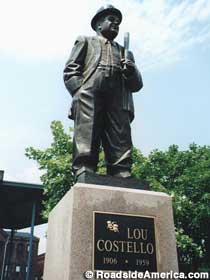
    <summary> Lou Costello memorial statue in Paterson, NJ This blog is ostensibly about fine art and I try to keep it on that topic as much as possible. But I do make occasional forays into other areas, as all three...</summary>
    <author>
        <name>Chris Rywalt</name>
        
    </author>
    
    
    <content type="html" xml:lang="en" xml:base="http://www.crywalt.com/blog/">
        <![CDATA[<base href="http://www.crywalt.com/">
<div class="dragme">
<p><img src="/blog/images/20100101/NJPATcostello.jpg" alt="" />
<p>Lou Costello memorial statue in <a href="http://www.roadsideamerica.com/story/2164">Paterson, NJ</a>
</div>
<p>
This blog is ostensibly about fine art and I try to keep it on that topic as much as possible.  But I do make occasional forays into other areas, as all three dedicated readers have certainly observed, and I intend to do so again now.
</p>
<p>
When it comes to fine art, to art that proposes to place itself with the greats of the past -- Rousseau, Van Gogh, Leonardo and Titian -- I'm very hard to please.  So were they.  That's part of how they got there, by demanding the very best of themselves and the art they looked at.
</p>
<p>
But when it comes to other things, less pretentious things, I'm not so hard to please at all.  In fact I'm like a kid.  And one thing I simply enjoy is weird stuff.  You know what I mean:  The kind of thing where somebody decides to collect garden gnomes and display them all in their front yard.  Or some bored automotive welder sculpts a robot-like man out of exhaust pipes.
</p>
<p>
It seems to me to be a peculiarly American trait to have a vision and see it implemented, whether that vision is <a href="http://en.wikipedia.org/wiki/Robert_Kearns">intermittent wiper blade motors</a> or <a href="http://en.wikipedia.org/wiki/Watts_towers">wiry towers of scrap rebar</a>.  I have a soft spot in my heart for those endeavors, the little invention that could or the crazy structure.  I love the idea of people who just forge ahead with whatever's in their head whether it makes sense or not.
</p>
<p>
It may be because of Mr. Trombino.  He lived down the street from me when I was growing up in Staten Island, New York.  I found out years later that he was a retired shop teacher; he'd retired before I was born.  I met him when using his yard as a path from an empty lot to my best friend's house.  My friend's house, like most of the houses in the neighborhood, was set close to the sidewalk with a small front yard and a large back yard.  But Mr. Trombino and his wife lived in the old carriage house that served the estate which was eventually broken up and sold into lots.  So his house was a small set of rooms attached to an enormous barn <a href="http://maps.google.com/maps?f=q&source=s_q&hl=en&geocode=&q=5+Arlington+Ct,+Staten+Island,+NY+10310&sll=37.0625,-95.677068&sspn=34.534108,79.013672&ie=UTF8&hq=&hnear=5+Arlington+Ct,+Staten+Island,+Richmond,+New+York+10310&ll=40.641426,-74.110208&spn=0.008076,0.01929&z=16&layer=c&cbll=40.641257,-74.110171&panoid=_dDImeU58myVw_WDBj_6Zg&cbp=12,223.37,,0,0.21">set all the way at the back of the property</a>.  Mrs. Trombino was in charge of gardening beds of flowers in the yard and Mr. Trombino spent his days coming up with things he wanted to make and making them.
</p>
<p>
When I first met him his line was in fish mobiles.  He'd make these large fanciful wooden fish, maybe three feet long, maybe ten, or anywhere in between, out of wood.  He'd paint them or varnish them or whatever looked good at the time, find the point at which he wanted to balance them, and hang them from the trees in his vast front yard.  As they decayed in the weather he'd take them down.
</p>
<p>
He was always restlessly working on something.  When I'd come by to visit he'd show me what he was doing and some days he'd have something in a box by the door for me.  He gave me my first book of Arthur C. Clarke short stories and my first book of Robert Heinlein short stories.  He gave me a tetrahedral puzzle. Once he handed me a transistor taped to a card, and he explained to me what it did.
</p>
<p>
Over the years I'd stop by and see what he was doing every so often.  The last time I spoke to him he had built a skeletal framework, painted it pink, and hung various things from it, including a bowling ball.  I remember saying it must've been tough to drill a hole in a bowling ball but he said it wasn't, you just needed to go slow.
</p>
<p>
He died a few years ago.  My parents finally moved out of the neighborhood, so I don't know if Mrs. Trombino is still there.  The Trombinos are the kind of neighborhood treasure that passes unremarked, remembered only by those who knew them.  There won't be a monument to Mr. Trombino; his works haven't been preserved; I wish I could go back and pay more attention this time, but that's life.
</p>
<p>
So I have a soft spot in my heart for people across this great land of ours who see something lacking in the world around them and go ahead to create it.  The World's Largest Ball of Twine.  Mount Rushmore.  <a href="http://www.roadsideamerica.com/muffler/">Muffler Men</a> (and <a href="http://www.roadsideamerica.com/muffler/art">men made of mufflers</a>).
</p>
<p>
I would never demean these people by calling them artists.  That would be an insult to their intentions.  They don't desire fame or money, power or influence.  All they want is to do what they want to do.  They are what makes this country great.
</p>
<p>
And now you too can find them, and many other things besides, thanks to the fine folks at <a href="http://www.roadsideamerica.com/">Roadside America</a>.  Yes, we've reached the shameless plug section of the article.  But I'm plugging shamelessly for the app developer, <a href="http://friendfeed.com/jdandrea">Joe D'Andrea</a>, because he's really a great guy and a good friend, and his app is bound to be excellent.  (Also you should check out Joe's band <a href="http://broadside.org/">Broadside Electric</a>, whose site is the best use of Dover Clip Art since <a href="http://www.crywalt.com/blog/2009/12/free-anti-plug.html">Saul Chernick</a>.)
</p>
<p>
Joe developed <a href="http://www.roadsideamerica.com/mobile/">Roadside America for iPhone</a>, an app which allows you to easily look for interesting, offbeat attractions near your location.  I'll never use it because I never travel anywhere, but I can see how it'd be useful.  Hop in your RV and wander the highways and byways of these United States and never grow bored.  I mean, the Oasis Bordello Museum in Idaho?  The Broken Angel House in Brooklyn?  A 33-foot Virgin Mary in Ohio?  All there!
</p>
<p>
You won't find Mr. Trombino on that app, but you can find his spiritual successors. Tell them you love them.
</p>
]]>
        
    </content>
</entry>

<entry>
    <title>Free Anti-Plug</title>
    <link rel="alternate" type="text/html" href="http://www.crywalt.com/blog/2009/12/free-anti-plug.html" />
    <id>tag:www.crywalt.com,2009:/blog//1.221</id>

    <published>2009-12-23T14:36:52Z</published>
    <updated>2009-12-23T14:48:46Z</updated>

    <summary> Just a quick note to let you know if you don&apos;t donate to Art Fag City&apos;s latest fundraiser you won&apos;t have a chance to be the high donor, who gets a wonderfully appropriate print from Saul Chernick: Derivative (straight...</summary>
    <author>
        <name>Chris Rywalt</name>
        
    </author>
    
    <category term="artfagcity" label="Art Fag City" scheme="http://www.sixapart.com/ns/types#tag" />
    
    <content type="html" xml:lang="en" xml:base="http://www.crywalt.com/blog/">
        <![CDATA[<div class="dragme">
<p><img src="/blog/images/20091223/doverpublications_2083_90237988.jpg" />
</div>
<p>
Just a quick note to let you know if you don't donate to <a href="http://www.artfagcity.com/2009/12/18/the-art-fag-city-year-end-fundraiser-2">Art Fag City's latest fundraiser</a> you won't have a chance to be the high donor, who gets a wonderfully appropriate print from <a href="http://www.saulchernick.com/">Saul Chernick</a>:  Derivative (straight out of a <a href="http://www.amazon.com/Medieval-Illustrations-Dover-Pictorial-Archive/dp/0486288625/">Dover clip art book</a>, in fact), pointless, overpriced at any price.  I guess if AFC had to pick a signature artist, a guy who makes Roy Lichtenstein look like a brilliant innovator and skilled draftsman is perfect.
</p>]]>
        
    </content>
</entry>

<entry>
    <title>Invitation Policy</title>
    <link rel="alternate" type="text/html" href="http://www.crywalt.com/blog/2009/12/invitation-policy.html" />
    <id>tag:www.crywalt.com,2009:/blog//1.220</id>

    <published>2009-12-23T01:16:18Z</published>
    <updated>2009-12-23T01:19:49Z</updated>

    <summary> James Ensor, La Colere, 1904, etching from a copper plate, with hand coloring, on ivory wove paper, 93 x 144 mm (image) I&apos;m instituting a new invitation policy. Please read before inviting me to your show. I&apos;ve discussed openly...</summary>
    <author>
        <name>Chris Rywalt</name>
        
    </author>
    
    
    <content type="html" xml:lang="en" xml:base="http://www.crywalt.com/blog/">
        <![CDATA[<base href="http://www.crywalt.com/">
<div class="dragme">
<p><img src="/blog/images/20091222/james_ensor.jpg" alt="James Ensor, La Colere, 1904, etching from a copper plate, with hand coloring, on ivory wove paper, 93 x 144 mm (image)" />
<p>James Ensor, <i>La Colere</i>, 1904, etching from a copper plate, with hand coloring, on ivory wove paper, 93 x 144 mm (image)
</div>
<p>
I'm instituting a new invitation policy.  Please read before inviting me to your show.
</p>
<p>
I've discussed openly before how, when I review a show of someone I know or have met, or a show I was invited to, I tend to be nicer than I ordinarily would.  Of course it's easier to say mean things about someone you've never met than about someone you've shaken hands with.
</p>
<p>
But over the years I've learned something:  Even when I try to be nice I make people angry.  Even when I try to be less critical than I would be usually, the people I write about get mad at me.
</p>
<p>
There are two ways I can approach this, then.  First, I can stop reviewing any shows by people I know.  Or, second, I can institute this policy.  Since I write art reviews -- it's what I do -- I won't be stopping.
</p>
<p>
If I'm going to get yelled at regardless, I might as well be totally honest.  So this is my new policy:  If you invite me to your show, or invite me to look at your art, I am going to be brutally honest.  This goes for anyone, whether they're friends, aquaintances, buddies, or dating my daughter.  You have my one hundred percent iron-clad money back guarantee that you will not like what I have to say.  You think you'll like it, but you won't.
</p>
<p>
If you still choose to invite me to your show, you've been warned.
</p>

]]>
        
    </content>
</entry>

<entry>
    <title>December 17, 2009</title>
    <link rel="alternate" type="text/html" href="http://www.crywalt.com/blog/2009/12/december-17-2009.html" />
    <id>tag:www.crywalt.com,2009:/blog//1.219</id>

    <published>2009-12-20T17:09:49Z</published>
    <updated>2009-12-22T04:44:46Z</updated>

    <summary> It took me long enough but I finally recovered from seeing the worst art show of all time and thus was able to get off my ample ass and into another traditional gallery slog. One benefit of waiting so...</summary>
    <author>
        <name>Chris Rywalt</name>
        
    </author>
    
    <category term="anatzarev" label="Ana Tzarev" scheme="http://www.sixapart.com/ns/types#tag" />
    <category term="audreykawasaki" label="Audrey Kawasaki" scheme="http://www.sixapart.com/ns/types#tag" />
    <category term="cathleencueto" label="Cathleen Cueto" scheme="http://www.sixapart.com/ns/types#tag" />
    <category term="davidhockney" label="David Hockney" scheme="http://www.sixapart.com/ns/types#tag" />
    <category term="denysethomasos" label="Denyse Thomasos" scheme="http://www.sixapart.com/ns/types#tag" />
    <category term="fairfieldporter" label="Fairfield Porter" scheme="http://www.sixapart.com/ns/types#tag" />
    <category term="francispicabia" label="Francis Picabia" scheme="http://www.sixapart.com/ns/types#tag" />
    <category term="georgesrouault" label="Georges Rouault" scheme="http://www.sixapart.com/ns/types#tag" />
    <category term="gerhardrichter" label="Gerhard Richter" scheme="http://www.sixapart.com/ns/types#tag" />
    <category term="hendriksmit" label="Hendrik Smit" scheme="http://www.sixapart.com/ns/types#tag" />
    <category term="jameswolanin" label="James Wolanin" scheme="http://www.sixapart.com/ns/types#tag" />
    <category term="johndeandrea" label="John DeAndrea" scheme="http://www.sixapart.com/ns/types#tag" />
    <category term="johnkacere" label="John Kacere" scheme="http://www.sixapart.com/ns/types#tag" />
    <category term="laurawatt" label="Laura Watt" scheme="http://www.sixapart.com/ns/types#tag" />
    <category term="lyndabenglis" label="Lynda Benglis" scheme="http://www.sixapart.com/ns/types#tag" />
    <category term="makotofujimura" label="Makoto Fujimura" scheme="http://www.sixapart.com/ns/types#tag" />
    <category term="nicoleeisenman" label="Nicole Eisenman" scheme="http://www.sixapart.com/ns/types#tag" />
    <category term="richardestes" label="Richard Estes" scheme="http://www.sixapart.com/ns/types#tag" />
    
    <content type="html" xml:lang="en" xml:base="http://www.crywalt.com/blog/">
        <![CDATA[<base href="http://www.crywalt.com/">
<p>
It took me long enough but I finally recovered from seeing <a href="http://www.crywalt.com/blog/2009/11/paul-mccarthys-white-snow.html">the worst art show of all time</a> and thus was able to get off my ample ass and into another traditional gallery slog.  One benefit of waiting so long between trips into Manhattan is I was able to put together a list of really interesting shows to see.  I even felt energetic enough to start at midtown, hit SoHo, saunter through Chelsea, and fetch up at the <a href="http://www.schoolofvisualarts.edu/">School of Visual Arts</a> MFA Open Studios.  The following morning my fasting blood sugar was the best it'd been in months, too.  Not a bad couple of days.
</p>
<p>
I began my trek on 57th Street at <a href="http://www.mariangoodman.com/">Marian Goodman</a> where I saw
</p>
<h2 class="section-title">
<a href="http://www.mariangoodman.com/exhibitions/2009-11-07_gerhard-richter/">Gerhard Richter</a>
</h2>
<p>
(until January 9, 2010)
</p>
<div class="dragme">
<p><img src="/blog/images/20091217/gerhard_richter.jpg" alt="Gerhard Richter, Abstract Painting (909-5), 2009, oil on something or other, 58 5/8x82 5/8 inches" />
<p>Gerhard Richter, <i>Abstract Painting (909-5)</i>, 2009, oil on something or other, 58 5/8x82 5/8 inches
</div>
<p>
I might not have put Gerhard on my list of shows to see except that over at <a href="http://artblog.net">Franklin's Artblog.net</a> a number of us started discussing his work across two separate threads, one nominally about <a href="http://artblog.net/?name=2009-12-08-09-10-bunny">Bunny Smedley</a> and the other <a href="http://artblog.net/?name=2009-12-11-08-23-bethea">George Bethea</a>.  He came up largely because Artblog's commenting pool mostly consists of Modernists, Abstract Expressionists, Color Field painters, and Greenberg readers.  The discussion tends towards a very high level since some involved knew Greenberg personally and were involved in the New York City art world back when all these topics were new and at the top of the field.  Since then, of course, painting's been declared dead a bunch of times, it's been declared undead, it's been decided that it was never dead, and abstraction -- which didn't really go anywhere -- is regularly hailed as returning, reconquering, reemerging, or whatever.  And of course one of the few really big art stars of the past twenty years or so working in a kind of Abstract Expressionist sort of way is Gerhard Richter.
</p>
<p>
I personally don't care about abstraction per se one way or the other, and honestly neither did Greenberg or anyone else properly calling themselves Modernist; for me (and for the others for whom I'm presuming to speak) the main thing is that the work of art be <i>good</i> regardless of style.  So I wasn't going to see Richter to see how well he fit under the label of Abstract Expressionism or any other label for that matter; I went to see for myself, after all our discussion of his work, if his paintings were any good.
</p>
<p>
And they aren't.  People talk about Gerhard's work being chilly or emotionless.  Well, distancing yourself from emotion is, in its own way, an expression.  It's communicating something.  I get nothing of the kind from Gerhard's work at all.  What I do get is the feeling of an assembly line, and not a very good one.
</p>
<p>
Most of the work in this show consists of Gerhard putting down paint of a few different colors and smearing it from one end of the surface to the other.  Then perhaps he'll put down another layer, possibly of different colors, and smear that, possibly perpendicular to the previous smear.  At times there's a hint that there may have been a more traditional painting at the very bottom which he's also smeared.
</p>
<p>
Then, aside from the assembly line pieces, there are a few works that, in context, appear to be one-time experiments on which he never followed up.  <a href="http://www.mariangoodman.com/exhibitions/2009-11-07_gerhard-richter/#/images/39/">Here's one where he sponged the paint on</a>, <a href="http://www.mariangoodman.com/exhibitions/2009-11-07_gerhard-richter/#/images/40/">here's one with solid squares of color arranged in a grid</a>, <a href="http://www.mariangoodman.com/exhibitions/2009-11-07_gerhard-richter/#/images/42/">here's a batch of paint-squished-between-glass</a>.  Just to break the monotony of putting the canvas flat and dragging a two-by-four across it, I guess.
</p>
<p>
He also varies his supports, which doesn't sound very exciting and isn't.  One's on canvas, another's on wood, yet another is on something called aludibond.  Altogether, what comes across from this entire show -- and it's a huge show -- go ahead, click through the whole thing at the gallery Website, I guarantee your clicker finger will fall off -- is Gerhard being willing to make choices so long as they don't figure very strongly into the final result.  He picks the colors, he picks the grounds, he does the same things to them, and he's done.
</p>
<p>
Worse still, he doesn't seem to care about the final result.  Clumps of pigment get dragged across the surface leaving gashes in the paint?  No problem.  Big boogery lumps on the end alligator up and threaten to fall off?  That's great!  (Come back in a hundred years and see how great it looks, Gerry.)  The latest layer pulls the skin off the only partially cured underlayer?  Just push it back into place, no one will notice.  No one says you have be anal retentive -- AbExers aren't exactly neat freaks -- but these flaws don't say "I'm pushing for the best art, I can't be bothered with details!"  They say "I just don't give a crap, where's the next one?"  Would the slightest nod towards professionalism and craft have killed him?
</p>
<p>
All of this carping would be beside the point if visually these paintings were great.  But they're not.  While I was there a couple of tour groups were milling around and I overheard some of the guide's spiel and felt embarrassed to be an artist.  The blathering was wide and deep and the poor souls roped into the tour were glumly nodding and accepting it.  "Yes, these are important paintings full of feeling.  Yes, they are passionate and intense.  Und so weiter und so weiter."  Anything but what was obvious, which is that even Gerhard was bored with them.
</p>
<p>
On my way out, waiting for the elevator, I scanned the various books for sale by the front desk.  Gerhard Richter is apparently so important he merits not merely one book for this show but at least five, one of which is entirely about just one painting.  <a href="http://www.mariangoodman.com/publications/september-a-history-painting-by-gerhard-richter/"><i>September</i> by Robert Storr</a> is a book-length essay (or an essay-length book, hard to say which) dedicated to "A History Painting by Gerhard Richter".  It says something about Gerhard's show and this painting in particular that it could be intended by the artist to engage with the September 11, 2001 terrorist attacks in America -- a topic about which I personally feel pretty strongly as a lifelong New Yorker who spent several years commuting daily through the World Trade Center -- and yet I didn't even notice until I was leaving, and then a book had to tell me.  In fact upon seeing the book I remembered that <a href="http://nymag.com/arts/art/reviews/62254/">Jerry Saltz had waxed rhapsodic about this very show</a> and its connecton to September 11.  That's how emotionally powerful this show is:  I didn't even remember or notice while I was actually looking at the work and neither, most likely, will anyone else, unless they bone up directly beforehand.
</p>
<p>
And that, ladies and gentlemen, is just sad.
</p>
<p>
The great thing about the address of the Marian Goodman Gallery, however, is that it's all very serious high art premium-priced galleries upstairs while the street-level part of the building is taken up by
</p>
<h2 class="section-title">
<a href="http://anatzarev.com/">Ana Tzarev</a>
</h2>
<p>
(open forever)
</p>
<div class="dragme">
<p><img src="/blog/images/20091217/ana_tzarev.jpg" alt="Ana Tzarev, Starvation, 1996, oil on linen, 51 1/8x38 1/4 inches" />
<p>Ana Tzarev, <i>Starvation</i>, 1996, oil on linen, 51 1/8x38 1/4 inches
</div>
<p>
and her personal vanity gallery.  I'm probably going to take a bit out of my already-tiny credibility even by saying I went through Ana's.  One dealer I spoke to -- and dealers very, very rarely say anything negative about anyone else -- said to me, "Isn't that a...<i>commercial</i> gallery?" as if I'd admitted to picking up Thai ladyboys on the weekends.  But I've been curious about Ana since her space opened up a couple of years ago -- she had these great billboards around town -- and here it was.  So I went in.
</p>
<p>
I'll say this:  Her gallery -- oh, hell, I might as well call it what it is, a store -- her store is a fantastic space.  I can't imagine how she affords it but it's just wonderful.  Any artist would wrestle Charlie Finch in hot oil to get a place like this.  It's huge and has none of the anonymous echoing white cube so beloved of real galleries.  It's warm and inviting, like a giant glowing womb.  With its own glass elevator.
</p>
<p>
As for Ana's paintings...well, they're certainly kitschy.  I can't deny that.  And she wears her love of Van Gogh not only on her sleeve but all over her smock -- she's even got the chutzpah to have painted a <a href="http://anatzarev.com/images/content/paintings/large/0972_GoldenSunflowers.jpg">vase of sunflowers</a> and a patch of irises, and further she's engaged in her own version of Japonisme (about a hundred years too late).  She falls far short in the comparison, but that's no shame, failing to match up to one of the greatest painters of all time.  Despite not being up to Van Gogh's level, though, her paintings are nevertheless big and colorful and energetic and honest and....
</p>
<p>
Okay, I can't really and truly love them.  I can't say my little dried-up art elite Grinch heart grew three sizes that day.  But it did thaw a bit, for just a moment.  Ana's got life and, in her paintings of people suffering from famine and disease in Africa, she's got some darkness, too.  She loves slathering on the paint, she's in love with paint itself; by the time you get to her most recent paintings she's squeezing it out like icing on a wedding cake.  And she's certainly got a thousand times more heart, courage, and brains than Gerhard Richter upstairs.  In a way Gerhard's work is just as kitschy in its refusal to be interesting or good as Ana's is in its puppylike need to be loved.  Ana sincerely wants to put something big and bright up on your wall; Gerhard sincerely doesn't give a shit.  I know which sincerity I'd choose.
</p>
<p>
I imagine someone might argue that other cultures and their problems aren't properly addressed by a touring European taking inspiration from their quaint suffering and marketing them for huge sums back in Whitey's capital city.  That turning flowers and starving people and women with baskets on their heads and onion domes and all that into big saleable commodities is crass and wrong.  And I don't really have much of an argument against that except I don't get that feeling from these paintings.  I've been in a Thomas Kinkade store, for example, and it's nothing like this.  Maybe it's naive of me, but I feel that Ana is really trying, in her own way, to connect with the people, places and cultures she depicts.
</p>
<p>
Maybe not.  Maybe she's just cashing in.  What do I know?
</p>
<p>
Anyway, I'd had no intention of stopping in Ana's store.  It just happened.  Where I really meant to go was <a href="http://www.tibordenagy.com/">Tibor de Nagy</a> to see
</p>
<h2 class="section-title">
<a href="http://www.picabia.com/">Francis Picabia</a> and 
<a href="http://www.artchive.com/artchive/P/porter.html">Fairfield Porter</a>
</h2>
<p>
(until January 23, 2010)
</p>
<div class="dragme">
<p><img src="/blog/images/20091217/francis_picabia.jpg" alt="Francis Picabia, French Can-Can, c. 1941-1943, oil on board, 41 3/4x30 inches" />
<p>Francis Picabia, <i>French Can-Can</i>, c. 1941-1943, oil on board, 41 3/4x30 inches
</div>
<div class="dragme">
<p><img src="/blog/images/20091217/fairfield_porter.jpg" alt="Fairfield Porter, Bear Island with Spruces, oil on board, 22x18 inches" />
<p>Fairfield Porter, <i>Bear Island with Spruces</i>, oil on board, 22x18 inches
</div>
<p>
These two shows are very, very small, in what, after the last two shows I saw, felt like very cramped quarters.  Nevertheless I wanted to go back to Marian Goodman and drag all those tour groups over with me, because there's more real human emotion in one small canvas from either Porter or Picabia than there is in two whole warehouse floors of Richter.
</p>
<p>
I can't go on for too long about either artist because I don't feel I'm qualified and the sample of work here is so small.  But I'll try to give you an idea of what I thought.
</p>
<p>
There are no masterpieces from Picabia here, although <i>French Can-Can</i> (pictured here) comes close.  It's the signature image of the show and with good reason: Either it's the reason there's a show at all or it's the piece expected to draw buyers in.  It's an excellent painting, forceful, lovely, forthright.  It looks like a cross between Picasso's Blue Period and a Degas dancer, with overtones of Toulouse-Lautrec (which is probably unavoidable when the subject is a French stage dancer around the turn of the 20th century).  And if it's a little off-kilter -- in composition, in rendering -- that just gives it a touch of interest.  Who'd want to hang out with an even-keeled dancer?  Where's the fun in that?
</p>
<p>
There's another painting of a standing female figure, too, a nude, in a much different style:  This time she's almost faceless, shadowed, in an ambiguous rocky place, and the modeling is much more realist, less cloisonn&eacute;.  It's luminescent in its own way, not really as dark as it first appears, and in its idealized form perfectly contemporary.
</p>
<p>
Also included are a few smaller paintings, some more abstract than others, mostly dark, and some lovely sketches, one a caricature of Man Ray on the cover of a menu, which exactly captures the essence of Parisian cafe culture, or anyway my imagining of it.  None of them are fantastic, especially compared to the dancer; the other paintings are mostly dark, clotted affairs, and some of them have so many overlapping elements it's hard to see them at all.  Still, they radiate a strength and a probing kind of exploration of the medium of paint.
</p>
<p>
Porter's part of the show -- I suppose they're really separate shows -- is even smaller than Picabia's and the work is less impressive.  I wish I could find a good reproduction of <i>Katie and Jacob in the Yard</i>, which I thought was probably the best piece there; in it two figures and the side of a house are dwarfed by a strand of trees and, most importantly, a lawn flooded with shadows and sunlight which almost appears to be coming alive like some enchanted fluid.
</p>
<p>
Aside from that painting, the work reminds me of <a href="http://www.alexkatz.com/">Alex Katz</a>, although much better.  What makes Porter work when Katz falls flat is hard to pin down:  Is it the colors?  The blending of edges Katz always seems reluctant to do?  Pure composition?  Painterly touch?  I'm not sure but it's clearly the case that Porter paints rings around Katz.  I'd like, in fact, to see them side by side, just to see if the comparison would reveal any clues.
</p>
<p>
As in the Picabia show, there are a few drawings from Porter, also.  They're very minimal, barely even sketches, possibly for future paintings he had in mind.  None of them -- there are two or three -- are very exciting.
</p>
<p>
On my way out of the building I shared the elevator with one Mr. Brown.  I know that was his name because the gallerina said good-bye to him as he left.  I expect he's some art world luminary I'm completely ignorant of.  (He was not, however, Eric Brown, co-director of Tibor de Nagy, whose photos I can find online.  Maybe it was his dad.)  Mr. Brown allowed me to press the button for the ground floor.
</p>
<p>
"I'm just following your lead," he said.
</p>
<p>
"Good thing you weren't following me earlier," I replied, "or you'd have gone through the Richter show."
</p>
<p>
"You didn't care for it?"
</p>
<p>
"It looked like it was made on an assembly line, like 'Shoop!  Shoop!'"
</p>
<p>
"Picasso worked that way sometimes, you know."
</p>
<p>
Unsure of how to respond to that, I simply said, "Well, Picasso wasn't always that awesome, either."
</p>
<p>
We wished each other well at the door and went our separate ways.  In this case my way was past the Plaza Hotel (where my high school held its Senior Prom) and the horsedrawn carriages to the subway and downtown to Prince Street and then to
</p>
<h2 class="section-title">
<a href="http://www.scholastic.com/">The Scholastic Bookstore</a>
</h2>
<p>
which isn't art-related at all -- I was looking for a gift for my son -- but is the only reason I happened to accidentally find and enter
</p>
<h2 class="section-title">
<a href="http://www.meiselgallery.com/">The Louis K. Meisel Gallery</a>
</h2>
<p>
where they were holding their 40th Anniversary Group Show (until December 18, 2009 -- you missed it!).  I'd like to list all the artists in the show but there were a whole lot of them and there was no handout from the gallery I could find.  Although there is a big rack of postcards for just 50 cents each.  The artists I definitely saw there:  Hilo Chen, Chuck Close, Richard Estes, Audrey Flack, Ralph Goings, John Kacere, David Parrish, John Salt, Ben Schonzeit, Jud Nelson and John DeAndrea.  I could tell from outside the place that the gallery was showing Photorealist work; upon entering I was blown away by the sheer volume of it, not to mention that there appeared to be a few naked women lounging around the place.  <a href="http://www.meiselgallery.com/lkmg/imagesDB/deandrea41.jpg">One</a>, in fact, was staring with somewhat disturbing intensity at the cluttered desk in the office.
</p>
<p>
I leaned over and whispered to the gallerina, "There are naked women in the gallery."
</p>
<p>
I guess she'd heard that too many times since she seemed unamused.  "It only seems that way, sir," she said, or words to that effect.  "They're all bronze."
</p>
<div class="dragme">
<p><img src="/blog/images/20091217/richard_estes.jpg" alt="Richard Estes, The Plaza, 1991, oil on canvas, 36x66 inches" /> 
<p>Richard Estes, <i>The Plaza</i>, 1991, oil on canvas, 36x66 inches
</div>
<p>
Indeed they were.  I left the small naked woman lying in the middle of the gallery, as if waiting for a massage, as I went slowly around the room.  I'd seen some of these paintings, or some very much like them, in airbrush books and magazines my whole life.  Not all of these artists use airbrush, but then not all of them are true Photorealists, as Richard Estes used to be.  I'm not sure he is any more; his more recent painting in this show struck me as more simply traditional landscape painting.  I suppose it's possible landscape painting caught up with the Photorealists.  I'm not sure.
</p>
<p>
In any case, I doubt you're likely to find a greater concentration of pure technique anywhere on the planet.  These are the works most likely to make regular people off the street say "Wow" and "How'd they <i>do</i> that?"  They're also some of the few art works which honestly need that ubiquitous "PLEASE DON'T TOUCH THE ART" sign because, damn, some of them you really want to feel.  I still get a little charge out of work like this -- I spent nearly 20 years trying to live up to it -- but in the end it's just not as great as I thought it was.  Still pretty neat, though.
</p>
<div class="dragme">
<p><img src="/blog/images/20091217/john_kacere.jpg" alt="John Kacere, C. Smith, 1972, oil on canvas, 56.5x80.5 inches" />
<p>John Kacere, <i>C. Smith</i>, 1972, oil on canvas, 56.5x80.5 inches
</div>
<p>
Standouts for me were <a href="http://www.meiselgallery.com/LKMG/artist/images.php?aid=30">John Salt</a>, who paints hazy images of old junked cars; <a href="http://www.meiselgallery.com/LKMG/artist/images.php?aid=78">Ben Schonzeit</a>, who had a large Photorealist airbrushed painting of a pile of apples with a lovely rendering of photographic depth of field (a curious thing to replicate, since it's kind of a flaw of optics, not really something we asked for); and <a href="http://www.meiselgallery.com/LKMG/artist/images.php?aid=22">John Kacere</a>, who I found notable mainly because his painting was enormous and entirely of one woman's derriere.  I consider myself something of an expert on the female backside, having painted a number of them myself over the past few years, so I looked up John when I got home and found that his oeuvre seems to consist almost entirely of giant paintings of women's asses.  In his online <a href="http://rogallery.com/kacere_john/kacere-biography.htm">bio</a> he states, "Woman is the source of all life, the source of regeneration. My work praises that aspect of womanhood."  Speaking as one guy who paints naked women I can tell you this:  John Kacere is full of shit.  I suppose he's approximately right, that woman is the source of all life, although it's more accurate to say exactly half of all creatures which reproduce sexually, since man is required for half the process, too.  Regardless, once you hit a word like "woman" as a stand-in for all women in an artist's statement, you know you're in trouble.  John should just come clean and say, "I paint women's asses because I like them.  I'm an ass man.  Now take off your pants."
</p>
<p>
Speaking of asses, there was me, carefully prowling around the edges of the gallery lest I go too quickly to the nude woman lying in the middle of the room.  But eventually I had to go and take a look.
</p>
<p>
I imagine not all sculptors, down through the ages, have sought to capture the human figure exactly.  But many have.  Certainly those old Italian guys working in the finest marble were trying their damnedest to make translucent white stone look like human skin.  With a lot of tricks and an application of immense skill, training, and talent, they did a great job.  But not perfect, never perfect.
</p>
<p>
Well, technology and techniques have improved over the years, and now it's possible to make an exact life cast of a living human without too much trouble.  I've even played with it myself.  It's easy to do.  Less easy is to take that life cast and have it made in bronze; and much more difficult than that still is to apply paint to that bronze until you have as close to an exact replica of a living person as anyone's ever seen.
</p>
<div class="dragme">
<p><img src="/blog/images/20091217/john_deandrea.jpg" alt="John DeAndrea, Amber Reclining, 2006, painted bronze with mixed media, life-size" /> 
<p>John DeAndrea, Amber Reclining, 2006, painted bronze with mixed media, life-size
</div>
<p>
And this is what <a href="http://www.meiselgallery.com/LKMG/artist/Images.php?aid=34">John DeAndrea</a> has done.  I was actually afraid to stare, afraid to get too close, because <a href="http://www.meiselgallery.com/lkmg/imagesDB/deandrea15.jpg">Amber</a> looked like she might get up and slap me.  The texture of her skin, the little goosebumps, every freckle and beauty mark, small folds of her toes, every little detail was there, flawless and lifelike.  No <a href="http://en.wikipedia.org/wiki/Uncanny_valley">Uncanny Valley</a> here, either.
</p>
<p>
The sculpture is not absolutely perfect:  Her hair isn't quite right, although I think it looked better in the gallery than in the photos, where it looks like plastic mannequin hair.  And there are places where John's paints couldn't reach.  In the tightest crevices, as between her folded arms, you can just see where the paint runs out and the bronze peeks through.  And finally I can't be sure -- although I knelt down to look at her face -- that part of why she didn't enter the Uncanny Valley is because she was facing away and down.
</p>
<p>
Altogether John DeAndrea's sculptures are a fantastic achievement.  I'm not sure they're great art, exactly, in that they don't have that feeling I associate with the very best art, that sort of elation that comes with seeing something truly sublime; but great art or not, they're certainly a triumph of technical skill.  In fact that could be said of everything in the gallery, but John's sculptures are that one step higher.  They're truly amazing.
</p>
<p>
Okay, enough serendipity.  Why was I really in SoHo?  Why, to stop by <a href="http://www.camptongallery.com/">Campton Gallery</a> to see
</p>
<h2 class="section-title">
<a href="http://www.jameswolanin.com/">James Wolanin</a>
</h2>
<p>
(until January)
</p>
<div class="dragme">
<p><img src="/blog/images/20091217/james_wolanin.jpg" alt="James Wolanin, Summer Meadow, 2009, acrylic & resin on panel, 48x48 inches" /> 
<p>James Wolanin, <i>Summer Meadow</i>, 2009, acrylic &amp; resin on panel, 48x48 inches
</div>
<p>
I won't be fully critical here, not because I don't want to be, but because it's just not possible.  Jim's a friend -- well, there I go again.  Friend's not quite the right word, since it's not like we exchange birthday gifts or borrow each other's underwear or anything.  But Jim was one of the first artists I met when I started my blog and he was one of the first to join me on a slog through Chelsea, and it was partly on his recommendation that I ended up at the School of Visual Arts in 2007, so I think of him as a friend even though I haven't seen him or his work in a couple of years.  The upshot is, whatever we are, I don't have the proper critical distance from his work, and even if I decided to bear down and really criticize it constructively, I'd probably do it privately.  Because I do have boundaries.  Not many and somewhat rickety, but boundaries nonetheless.
</p>
<p>
The first thing I saw as I arrived at the gallery is Jim's name in big letters at eye level along with one of his big new paintings right there in the front window.  It's absolutely great to see someone I know getting that kind of exposure.  Jim deserves it.
</p>
<p>
Inside I noticed something new about Jim's latest paintings: They're really shiny.  Look in the media list -- see where it says "acrylic resin"?  I wasn't sure how he used it but now I know:  He's been covering his paintings with <a href="http://www.eti-usa.com/consum/envtex/envlite.htm">Envirotex Lite</a>.  I played with that stuff a bit myself and I was really impressed by his handling of it:  To cover a surface as large as these paintings without a lot of flaws -- dust and hairs and things getting stuck -- and bubbles -- although there were a few tiny ones -- and to get the sides covered too, it's quite an accomplishment.  Of course the thick resin coating really saturates the colors of the paints, and Jim's acrylics are always very bright anyway, so the finished effect just screams POP!
</p>
<p>
Which is what these are, Pop Art.  They're mostly of groovy men and women in hairstyles and clothing placing them somewhere in the early 1960s.  Some are in cars, some are in front of planes, some are at the pool.  There's always a sense of being on some kind of movie poster or travel brochure vacation -- martinis!  Palm trees!  The whole set is like a spread from an early issue of Playboy or maybe Vanity Fair.  The image here, <i>Summer Meadow</i>, is one of the few exceptions.  (The horse in the background makes me hope the nice lady checked the grass before she laid down.)
</p>
<p>
Jim's style hasn't changed a lot but I thought I picked up some small differences.  He's working larger now.  Also I think his forms are getting more stencily.  He's always cut stencils or taped off areas (I forget his exact method) but it looks to me as if some of the edges are straighter and some of the corners sharper.  Two paintings in the show are identical except for the color scheme, which makes me think he's reusing stencils.  This also opens up questions about editions:  Are these edging closer to serigraphs now?
</p>
<p>
Although I said I wasn't going to get too critical I will add a little:  I'm still unsure of Jim's subject matter.  I can't quite feel his connection to it.  Back when <a href="http://www.crywalt.com/blog/2006/08/timothy-mutzel-sva-open-studios.html">he was at SVA</a> his work was moving in a more personal direction which I thought was really good, but something seems to have short-circuited that, as if he touched some live wire and took a couple of steps back again.  It could be, I guess, that he went down one of those fruitless avenues artists sometimes take while they're exploring in the studio.  It looked like a good place to me, but maybe not to him, and he is, after all, his own artist.  The resin surface, while aesthetically neat, adds a little more distance too, I think.  The whole package sort of unsettles me.
</p>
<p>
But that's really a minor caveat.  I like the work, I really do.  And when I wrote to Jim after seeing the show he gave me some good news and some bad news:  The bad news is, I missed almost half the paintings in the show; the good news is, that's because they sold and were shipped to their new owners already.  Which is excellent to hear, although I wonder why the gallery didn't at least let the paintings stay for the rest of the show.  The place doesn't do opening parties, either, so perhaps it's a...gasp...<i>commercial</i> gallery?  Well, if it pays Jim's bills and keeps him painting, I for one don't care.
</p>
<p>
Jim is certainly doing better than the sidewalk artists.  Over in Chelsea, or on the Lower East Side or midtown, for that matter, you don't get people setting up on the sidewalk hawking their wares.  In Chelsea it's because there's relatively little foot traffic, at least of the shopping kind; in midtown it's because the galleries up there will call the police if you're within a hundred yards of their door.  But SoHo has been burnished over the past few decades into the general public's idea of the New York Art Scene, so it's expected that starving artists will lug their life's work downtown and attempt to pass it off on unwary passersby.  Most of it is street art, graffiti on canvas kind of thing, and mostly forgettable.  But one guy I passed was selling drawings of comic book superheroes he'd clearly traced from my personal hero <a href="http://www.byrnerobotics.com/">John Byrne</a>.  It's something most people might not have noticed but it made me mad.  I thought of challenging the guy to draw Wolverine in front of me without a Byrne to copy.  But then I decided to leave him alone.  It is, after all, Christmas.
</p>
<p>
And I had to get to Chelsea.  As it happened almost everything I wanted to see was on 25th Street so naturally I started with my favorite gallery, <a href="http://mckenziefineart.com/">McKenzie Fine Art</a>, and my favorite dealer, Valerie McKenzie, who was showing
</p>
<h2 class="section-title">
<a href="http://mckenziefineart.com/exhib/Watt2009exhb.html">Laura Watt</a>
</h2>
<p>
(until December 19, 2009 -- you missed another one)
</p>
<div class="dragme">
<p><img src="/blog/images/20091217/laura_watt.jpg" alt="Laura Watt, 50402, 2004, oil on canvas, 36x34 inches" /> 
<p>Laura Watt, <i>50402</i>, 2004, oil on canvas, 36x34 inches
</div>
<p>
Valerie seems to love the kind of artist who covers the surface with a repeated pattern, often in some kind of spiral or spinning column.  Maybe she has an inner ear problem or something.  Or maybe I just happen to show up when she's showing that kind of work.  Whatever it is, I often find myself feeling a little dizzy in her gallery.
</p>
<p>
Laura's show is a prime example of both the pleasures and the pitfalls of this kind of painting.  Most of her work here consists of medium-sized canvases on which she's taken a motif and repeated it, twisting, folding, and otherwise transforming the shape as she goes.  In some she then lays on another motif, possibly similar to the first, and runs that across the surface, again transforming it.  Her transformations are very mathematical, sort of plane deformations, the kind of thing I used to have a name for back when I was studying mathematics but which escapes me now.  In contrast to the specificity of her transformations, her paint handling is somewhat loose, not too precise.  In a way I found myself wishing she was tighter, but then that might drain the work of all spontaneity and life.
</p>
<p>
The range of paintings she's done using this approach perfectly illustrates the pros and cons of abstract painting:  When it works -- when she's chosen good colors and composed the deformations well -- it's really good; but when it doesn't work the painting completely collapses.  She's working with small-sized pieces -- in Cubist terms -- and putting them together into an all-over composition, and when the colors contrast just so, and the two or more overlapping patterns work together in their shallow Cubist space, the effect is quite good (see <a href="http://mckenziefineart.com/artists/watt/lw10007.html"><i>Mandala Crossed #1</i></a>).  When she chooses the wrong color combination, or somehow doesn't get the patterns to match up in a pleasing way, there's just nothing there at all.  The whole painting simply fails (see <a href="http://mckenziefineart.com/artists/watt/lw10009.html"><i>Indra</i></a>).
</p>
<p>
Of course there's probably no way to know in advance what will work and what won't, which is why it's a hit and miss process.  When it works it works, though, and that's important.  She also does the same kind of thing in gouache and I found those much more successful than the oils.  I'm not sure why; it could be that the lack of saturated colors brings the composition and shapes out better.  Remember that Braque and Picasso kept their hues very close together when inventing Cubism, and there's a reason for that.  It could also be the even less precise edges of the gouache helped wake the whole thing up.  I'm not sure but I liked them.
</p>
<p>
Best of all, though, is the signature piece, <i>50402</i> (shown here).  This time Laura's taken what might be Chuck Close's little filled rectangles and deformed them across the surface, giving us a kind of 3D wireframe of some abstract object, or something reminiscent of Dal&iacute;'s figures fading in and out of existence.  This is an older work and not, I guess, the kind of thing she's doing these days, but it struck me as more satisfying than the newer paintings.
</p>
<p>
I said good-bye to Valerie and went downstairs and across the street since my next stops were even-numbered buildings.  Since I was there I ducked into <a href="http://www.lennonweinberg.com/">Lennon, Weinberg</a> where I saw
</p>
<h2 class="section-title">
<a href="http://www.lennonweinberg.com/artists/thomasos/thomasos_unique/thomasos_1.html">Denyse Thomasos</a>
</h2>
<p>
(until January 9, 2010)
</p>
<div class="dragme">
<p><img src="/blog/images/20091217/denyse_thomasos.jpg" alt="Denyse Thomasos, Lollipop Nation, 2009, acrylic on canvas, 40x54 inches" /> 
<p>Denyse Thomasos, <i>Lollipop Nation</i>, 2009, acrylic on canvas, 40x54 inches
</div>
<p>
I don't know who chooses the art in this gallery, whether it's Weinberg or Lennon or some other person, but I feel schizoid about their choices.  I always seem to be drawn into the gallery but I never really like the art.  Neither do I dislike it.  It's almost always sort of distressingly uninteresting.
</p>
<p>
Denyse Tomasos is no exception.  Her work is in a quasi-Cubist style with angular forms and flat colors which are slightly off-register from each other.  It reminds me of that late 1950s to early 1960s illustration style which has no name I'm aware of but which really needs one.  It's kind of Saul Bass meets Hanna-Barbera's Pink Panther cartoon backgrounds.  All the paintings in this show look as if Denyse applied that approach to waterfront scenes filled with dock buildings and sailboats tied up at wooden quays.  It's almost but not quite the kind of painting one would put in an ornate wooden frame and hang in <a href="http://www.lileks.com/institute/interiors/BHG/chpt11/6.html">a living room decorated in Better Homes &amp; Garden circa 1975</a>.
</p>
<p>
The only good thing about a small gallery filled with mediocre art is you can go through and around it quickly and right back outside to your next destination, which in my case happened to be <a href="http://www.532gallery.com/">532 Gallery Thomas Jaeckel</a>.  The door to the building is opaque and when I stepped through it I made a little squeak because I faced what looked like the longest staircase of all time.  In fact it isn't, but it's a weird old building where the architect decided, for reasons I cannot imagine, to run the stairs straight up without turning at landings all in one run to the third floor.  Any fat man faced with that many stairs would've made the same noise I did.  Thankfully the gallery is only on the second floor.  Thus I was only slightly out of breath when I saw
</p>
<h2 class="section-title">
<a href="http://www.hendriksmit.com/">Hendrik Smit</a>
</h2>
<p>
(until December 24, 2009)
</p>
<div class="dragme">
<p><img src="/blog/images/20091217/hendrik_smit.jpg" alt="Hendrik Smit, Untitled, 2009, acrylic on board, 41x56 inches" /> 
<p>Hendrik Smit, <i>Untitled</i>, 2009, acrylic on board, 41x56 inches
</div>
<p>
The same way that Laura Watt's work shows what can go wrong with abstract painting, Hendrik Smit shows what can go wrong with Abstract Expressionist painting.  Unlike her, however, his work never shows what can go right.
</p>
<p>
The gallery verbiage bills Hendrik "as one of the last true inhabitants in the world of action painting," a mouthful which says, basically, that he's not paying attention to the final results so much as how he gets there -- and it shows.  Each one of the paintings here is a portrait of an artist vigorously applying any and all acrylic colors in whatever way he feels without regard for composition, coherence, quality or purpose.  Each one might as well be an entirely random agglomeration of sticky, gummy plasticized pigment.  Each one looks essentially the same as the last and not one of them has any discernable depth or structure.  This is Abstract Expressionism at its worst:  Cut free from any connection to solid painting, let loose from any boundaries at all, and clearly the result of someone completely misunderstanding how abstraction works.  I get the impression that Hendrik looks at paintings by artists like Jackson Pollock, Jack Tworkov and Joan Mitchell and thinks, "Oh, they just slapped paint all over the place."  You'd have to be pretty insensitive to think that way, but judging by his results, that's what he takes from them.
</p>
<p>
Back down the scary stairs and next door at <a href="http://www.pacewildenstein.com/">PaceWildenstein</a> I went in to see
</p>
<h2 class="section-title">
<a href="http://www.hockneypictures.com/">David Hockney</a>
</h2>
<p>
(until December 24, 2009)
</p>
<p>
A few years ago if you'd asked me what I thought about David Hockney, I'd have said I thought he was a pretty poor painter.  I'd remember those old pool paintings and so forth, and although I didn't have the term for it, I'd probably have said he's a forerunner of the Feeble Painting movement.  Only during a period where people were saying painting is dead could a guy like Hockney get traction.
</p>
<p>
Then I read his book, <a href="http://www.amazon.com/Secret-Knowledge-New-Expanded-Rediscovering/dp/0142005126/"><i>Secret Knowledge: Rediscovering the Lost Techniques of the Old Masters</i></a>.  Not only did I find his thesis credible and interesting -- I won't go into it here -- I got the feeling from his writing that I get from certain authors, the feeling that I'm actually becoming friends with them, speaking with them personally.  After reading his book, then, I felt like David was an acquaintance of mine, and I found myself looking forward to seeing his work in person again some day so I could see it with new eyes.
</p>
<p>
A funny thing about the show at Pace is I had walked halfway into it before realizing <i>I'd already seen the show before</i>.  I had, in fact, walked through it back in October.  I hadn't written it up then because it got caught in the backwash from <a href="http://www.crywalt.com/blog/2009/11/paul-mccarthys-white-snow.html">that dreadful show</a> but, more importantly, when I was looking up shows to add to my itinerary this time, I'd put David's show on the list without even remembering I'd been to it.  That in itself says something about the work on view -- that less than two months later I'd have no memory of it at all.
</p>
<p>
So what this show confirmed for me is that I like David Hockney much better as a writer than a painter.  As a writer I feel he's my friend but as an artist I feel he's a doddering old uncle we're all humoring for some reason.  Maybe we're hoping he'll leave us something in his will.
</p>
<div class="dragme">
<p><img src="/blog/images/20091217/david_hockney.jpg" alt="David Hockney, Winter Timber, oil on 15 canvases, 108x240 inches" /> 
<p>David Hockney, <i>Winter Timber</i>, oil on 15 canvases, 108x240 inches
</div>
<p>
The paintings in this show range from the merely big to the absolutely huge, some around <i>twenty feet wide</i>.  Yes, that's right, twenty feet.  They are brightly colored, nearly fluorescent, with large sinuous forms, like enormous Day-Glo sausages, snaking over the surface, balanced by huge blocky areas of primary greens and light blues.  They're ostensibly landscapes -- according to the gallery verbiage some of them <i>plein air</i> -- but in no way realistic.  In fact Ted Geisel might have had views like this if he ever dropped acid while suffering from a head cold.
</p>
<p>
There are some positive things to be said about David's work here.  It's courageous.  He clearly has no fear of using pigments usually found in grade school tempera sets.  In fact his work reminds me of the paintings kids bring home from school.  They have that complete abandon, that total immersion in the painter's world without considering what anyone else might like.  It's commendable to see anyone attacking a canvas with that kind of energy.
</p>
<p>
Sadly, while David doesn't need to consider what anyone else might think, he does need to look at his own work with a more critical eye.  He's got the color sense of a demented Fauve and the paint handling of a palsied Guston and he really needs to figure out what he's doing.  I appreciate his desire, expressed in the <i>Secret Knowledge</i> book, to get away from what he calls optics in art -- the use of photographic techniques -- and to paint what he actually sees and feels.  The gallery verbiage quotes Lawrence Weschler as writing, "...it was as if, after over twenty years of myriad wanderings, he'd found a figurative (non-abstract) way clean past the monocular optical vise."  I think this is a laudable goal and it's one I'd been pursuing unknowingly before, and consciously since, reading David's book.  But how this anti-optics approach -- the approach of using one's own eyes rather than photos, lenses, and received wisdom on "how things look" -- leads to purple paths meandering around blue trees and waving baguette-like tentacles on primary-green bushes is beyond me.  To say nothing of the creeping mauve shadows and clouds roiling with pinky-russet tendrils.  If this is how things really appear to David, perhaps he needs a run through an MRI machine.
</p>
<p>
Ultimately what's wrong with the paintings is, while they seem plenty wild and outrageous when you're looking at them, they turn out to be forgettable.  I certainly forgot them.  For all their size and color and craziness, they simply don't hang together as art, and slide right out of mind.
</p>
<p>
Outside once more I crossed 25th Street and found myself in front of <a href="http://www.cheimread.com/">Cheim &amp; Read</a>.  What the heck, I thought, and went inside where I saw
</p>
<h2 class="section-title">
<a href="http://www.cheimread.com/exhibitions/2009-11-19_lynda-benglis/">Lynda Benglis</a>
</h2>
<p>
(until January 2, 2010)
</p>
<p>
and got a fantastically stiff, fantastically large (6 3/4 by 9 1/4 inches) show postcard which thankfully contains no image of Lynda's crappy sculptures on it whatsoever.  The back is entirely blank, in fact, and I think I might make a nice drawing on it.
</p>
<p>
A few doors down I made it to <a href="http://dillongallery.com/">Dillon Gallery</a> which has a very interesting show comparing and contrasting the work of two very different artists,
</p>
<h2 class="section-title">
<a href="http://dillongallery.com/index.php?p=exhibits&id=current&exh=200911_soliloquies">Georges Rouault and Makoto Fujimura</a>
</h2>
<p>
(until December 24, 2009)
</p>
<div class="dragme">
<p><img src="/blog/images/20091217/georges_rouault.jpg" alt="Georges Rouault, Payasage africain (aux trios barques), 1920, oil, gouache on canvas, 16x18.4 inches" /> 
<p>Georges Rouault, <i>Payasage africain (aux trios barques)</i>, 1920, oil, gouache on canvas, 16x18.4 inches
</div>
<div class="dragme">
<p><img src="/blog/images/20091217/makoto_fujimara.jpg" alt="Makoto Fujimara, Soliloquies-Morning, 2009, mineral pigment on portrait linen, 60x48 inches" /> 
<p>Makoto Fujimara, <i>Soliloquies-Morning</i>, 2009, mineral pigment on portrait linen, 60x48 inches
</div>
<p>
I was attracted to this show because a year ago <a href="http://artblog.net/?name=2008-12-04-10-41-rouault">Franklin had gone to a Rouault exhibition</a> and made <a href="http://artblog.net/index.php?name=2008-12-02-15-04-rouault">some drawings of his own</a>, which I'd seen and liked.  The twist to this show is that it juxtaposes Rouault's work with a series of paintings responding to it in some fashion.  I'm not exactly sure how it was supposed to work, whether each painting by Makoto Fujimara is a direct response to a particular work by Rouault or not, but in the end I'm not sure it's that important.  What is interesting is seeing the two side by side -- Georges' early to mid-20th century expressionism up next to Makoto's contemporary color field work.  They're opposites in many ways, but each very good in their own ways:  Georges' paint is laid on thickly, often caked on in so many layers that the surface must be almost an inch from the canvas backing; while Makoto's paint barely stains the canvas.  Georges' colors are subdued, dull; Makoto's are sharp, vibrant.  Neither of their works conjure up an illusion of space.  Georges makes one or two stabs at perspective, but really never gets deeper than the picture plane.  And Makoto is a true color field painter of the old school with no depth at all.  Some of his paintings have layered gold leaf on top of the staining, but even so they stay very shallow.
</p>
<p>
One thing they do have in common is that both painters communicate emotion.  Georges is all passionate intensity while Makoto feels more introspective, contemplative; it's almost the stereotype of the reserved Japanese versus the fiery Frenchman.  Both are good painters on their own, but together the contrast improves them both.
</p>
<p>
After leaving that show I headed downtown a few blocks.  On the way I stopped at <a href="http://www.leokoenig.com/">Leo Koenig</a> for one reason only.  It sometimes occurs to me that I often review an artist and never see their work again.  I don't follow along with too many.  They get their one shot, and even if I like them, I don't seem to see them again.  And sometimes I think that's a sign of my unprofessionalism.  If I were serious about being an art critic, I think, I'd return to artists and evaluate their work anew.
</p>
<p>
Which is why I ended up seeing
</p>
<h2 class="section-title">
<a href="http://www.leokoenig.com/exhibition/view/1796">Nicole Eisenman</a>
</h2>
<p>
(until December 23, 2009)
</p>
<p>
So now I can say this:  Nicole Eisenman <a href="/blog/2006/06/chelsea-gallery-slog-2.html">still</a> sucks.
</p>
<p>
Whew.  Now, at long last, we come to one of the reasons I left the house in the first place.  I'd made a list of things to see, as I said earlier, but there were really only two shows that got me out specifically on this date.  One was the SVA MFA Open Studios and the other was at <a href="http://jonathanlevinegallery.com/">Jonathan LeVine Gallery</a>.
</p>
<p>
Over on the left-hand side of my page (as I write this in late 2009) there's a list of links.  If you've paid any attention to it at all you've probably wondered what the heck I'm thinking with those.  To be honest, I'm not thinking about them much at all.  Most people seem to think their Web pages are places where they can publicize all the things they like, from artists to musicians, from cute cat photos to gossip rags, from friends to people they're hoping will one day notice them.  Personally I don't give a crap.  I don't want to know what you like, what music you listen to, what food you cook.  Your tastes are probably pretty terrible anyhow.  And on my own page, I'm mainly interested in being an end point, not a place for you to browse past on your way to somewhere else.  So I don't really care about making and updating lists of links for you to visit when you've realized you don't want to read my writing any more.
</p>
<p>
However I do have some links there.  They're to people I thought were interesting at some point, who I thought could maybe use a link, or maybe they're friends I felt obliged to link to.  I don't really add to the list unless something very interesting comes up.
</p>
<p>
You'll note that one of those links is to Audrey Kawasaki.  And you might wonder why.  I wonder myself sometimes.  Stephanie has called her art kitsch, and she might be right.  There are times when I have trouble detecting kitsch.  What I do know is that Audrey's work struck me as interesting at some point and I've kept up with her site ever since.  Part of it is probably that Audrey is a woman making paintings of naked women.  I have to admit to a weakness for that -- I wouldn't be surprised if a lot of guys have that weakness.  <a href="http://www.eolivia.com/">Olivia De Berardinis</a> has done pretty well for herself, for example.  Part of it is the whole waify topless chick thing -- I'll admit to some prurience here -- and part of it is the whole fairy Goth thing, which I find perplexingly attractive at times.  I'm actually not sure how the whole thing comes together for me; I think I'm also interested in how popular Audrey's work seems to be and the basic fact that I could probably do what she does.  There are elements to her work that I've always been partial to -- the strong outlines and standard figures go back to my comic book days.
</p>
<p>
However all that fits together, I wanted to see her show, and so I eventually got to the LeVine Gallery and saw, for the first time in person, the work of
</p>
<h2 class="section-title">
<a href="http://jonathanlevinegallery.com/?method=Exhibit.ExhibitDescription&ExhibitID=50453F1A-19DB-5802-E0A84B5BF9099F56">Audrey Kawasaki</a>
</h2>
<p>
(until January 9, 2010)
</p>
<p>
<div class="dragme">
<p><img src="/blog/images/20091217/audrey_kawasaki.jpg" alt="Audrey Kawasaki, Kazamachi (Waiting), 2009, oil and graphite on wood, 76.2x76.2 cm" /> 
<p>Audrey Kawasaki, <i>Kazamachi (Waiting)</i>, 2009, oil and graphite on wood, 76.2x76.2 cm
</div>
<p>
Her work is very consistent:  She draws in pencil over raw wood (I'm not sure if she seals it in some way first), then paints over that in thin translucent glazes.  Her figures are usually slim and nearly vaporous, usually gamines, sometimes feminine young men.  Flowers, birds, smoke, clouds, leaves, and other items swirl or float around.  Sometimes the motif is very decorative, evoking Art Nouveau (especially, of course, Alphonse Mucha); sometimes the overall feeling reminds me of 1960s or 1970s home decor painting.
</p>
<p>
This show makes it clear that Audrey has mastered her medium.  The most original thing about it is probably using the wood as her ground and midtone; shadows are pencil hatching, and highlights are smoky layers of paint.  Still, as modern as these seem -- they're so very <a href="http://www.juxtapoz.com/">Juxtapoz</a> (she's been featured in the magazine more than once) -- at bottom they're extremely traditional.  If instead of wood she used panels stained with streaked burnt umber, she'd be painting in dead center Old Master style:  Let the shadows be transparent and the highlights opaque, paint from dark to light, use outlines where necessary to delineate form.  Obviously there are superficial details borrowed from manga, comic books in general, and pin-ups.
</p>
<p>
As always when an artist repeats a theme over and over I have to wonder if they've found something with which they can express themselves or just something that is easy and will sell.  I think in Audrey's case it's a little of both.  I feel she's sincere in her art but also she's gotten these figures down pat; there's no sense of exploration, of danger.  Each girl has basically the same languid expression regardless of whether she's surrounded by chrysanthemums or crows, whether she's floating nude underwater or hugging a friend.
</p>
<p>
For me, though, the ethereal hazy weightlessness of all her paintings outweighs my questions; I like her technique aside from her subjects and if they get a little repetitive all in a row, well, that's no big problem.  They're certainly not great art but I still can't tell for sure if they're kitsch.
</p>
<p>
Finally, timing it perfectly, I left Audrey's show and walked over to the School of Visual Arts to see the MFA Open Studios.  I'd been invited over by the wonderful <a href="http://www.cathleencueto.com/">Cathleen Cueto</a> who is scheduled to receive her MFA in May.
</p>
<p>
Once again I'm going to have to be an uncritical person, this time even more than with Jim, because I totally love Cathleen.  <a href="/blog/pws/2007/07/school-of-visual-arts-2007-part-2.html">We were at SVA together for the Summer Residency in 2007.</a>  So there's simply no way I can be remotely critical of her work.  It'd probably be improper of me, in fact.
</p>
<p>
I will say that nothing she's done has been as excellently excellent as the <a href="/blog/2006/08/timothy-mutzel-sva-open-studios.html">first thing I ever saw her do</a>, which was before I even knew her.  Her current installation seems warmer and deeper than her previous ones, maybe because there's some finished wood in this one.  I like her working space, though, because it has little bits and pieces from all her previous installations, including paint chips, which she still uses as handwritten business cards.
</p>
<p>
Her current installation involves a few pieces of furniture, some cookies (made, sadly, of sawdust), a couple of dried bugs in jars suspended by string, a hand-drawn sampler with some lines about spider and flies, a box with a collection of seashells, and a baby photo matted in cardboard.  It's Cathleen's idea, she said, of what a spider's parlor might be like, including elements of motherhood, protection, children, and, naturally, dead bugs.
</p>
<p>
Cathleen has now collected dead bugs for at least two of her pieces and it's a bit weird.  Girls aren't supposed to collect dead bugs.  Or live ones.  Or bugs of any kind.  Also, while I was there, a woman walking through the installation caught one of the bug jars directly in her eye.
</p>
<p>
Cathleen's dad showed up with a bottle of some kind of fizzy wine which he handed out in cups.  I ended up with one although I'd said I don't drink, but with the cup there I felt that I should, so I did.  It went directly to my head and the room began to gently spin.  Mr. Cueto claimed it had less alcohol than champagne but it knocked me for a loop.
</p>
<p>
While there I went through the BFA studios downstairs and the rest of the MFA studios.  What I found was that the BFA students are all really, really young and beautiful with young beautiful friends all having a party, particularly the one guy dressed as a very skinny Santa with a woman dressed as a hoochie elf.  They appeared to be setting up to film a Christmas-themed porno, although I doubt that was the intention.
</p>
<p>
A very few artists stood out.  There was <a href="http://mfafineart.sva.edu/current_students/CS_10_davis_caldwell/katherine_davis_caldwell.htm">Kate David Caldwell</a> who had this huge charcoal, seemingly abstract drawing but which, judging by her site, might be photographically based; <a href="http://mfafineart.sva.edu/current_students/CS_10_stahl/kevin_stahl.htm">Kevin Stahl</a>, whose work I cannot remember at all but I took his card so I must have liked it a bit (and the work on his page at SVA doesn't ring a bell); and Felipe Garcia, whose work I don't remember and can't really find online.  There's <a href="http://www.schoolofvisualarts.edu/sa/index.jsp?sid0=201&page_id=139&event_id=1034">this one page</a> with some of his stuff on it.  No bells ringing there, either.   But I took his card, too, so I must've liked him.  With luck I'll see these people again some day.
</p>
<p>
Seeing all the BFA candidates in one place caused me to formulate a theory on What's Wrong with the Art World Today which I may share with you sometime.  But as the wine made its way through my system I realized I'd been out a long time and was getting tired.  I'd been at SVA for an hour and was running out of steam.  So I took my leave and went home.
</p>
]]>
        
    </content>
</entry>

<entry>
    <title>Recent Stupidities</title>
    <link rel="alternate" type="text/html" href="http://www.crywalt.com/blog/2009/12/recent-stupidities.html" />
    <id>tag:www.crywalt.com,2009:/blog//1.218</id>

    <published>2009-12-16T17:38:45Z</published>
    <updated>2009-12-16T21:29:02Z</updated>

    <summary> DUH I should be getting back to actual reviews shortly. I&apos;m hoping to go on a gallery slog tomorrow and that should get me something to write about. I feel bad because I have a small stack of postcards...</summary>
    <author>
        <name>Chris Rywalt</name>
        
    </author>
    
    
    <content type="html" xml:lang="en" xml:base="http://www.crywalt.com/blog/">
        <![CDATA[<base href="http://www.crywalt.com/">
<div class="dragme">
<p><img src="/blog/images/20090901/dunce.jpg" alt="DUNCE" />
<p>DUH
</div>
<p>
I should be getting back to actual reviews shortly.  I'm hoping to go on a gallery slog tomorrow and that should get me something to write about.  I feel bad because I have a small stack of postcards from shows I meant to write about, but I saw them the same day I saw <a href="/blog/2009/11/paul-mccarthys-white-snow.html">that hideous show</a> and writing that burned me out.  Now it's too long after seeing the others, some of which were very good, for me to write them up.  It's a personal problem:  Sometimes things just go stale.
</p>
<p>
Not long ago <a href="http://ohprettylady.blogspot.com/">Stephanie</a> wrote to me to say, among other things, "Be aware that venting, no matter how justified, just makes you look bad if 95 percent of your output isn't of the 'and now back to the things that are interesting and worthwhile' variety."  Despite this advice, I'm going to vent some more.
</p>
<p>
In the course of my ramblings through the art world and its online adjuncts I often find people saying, doing, and writing down egregiously stupid things.  Sometimes I devote a short blog post to them and sometimes I just let them slide.  I've decided that, today at least, I have enough of these saved up to put them all in one place.  I'd like to imagine this will become a regular feature, in which case I'd call it "The Week in Stupidity" maybe, but I don't know if I'll keep it up.  So for now here is Recent Stupidities.
</p>
<img class="separator" src="/blog/images/DUH-button.jpg">
<p>
<a href="http://www.artinfo.com/news/story/33451/united-states-artists-names-10-visual-arts-fellows/">ARTINFO reports</a> that an organization called <a href="http://www.unitedstatesartists.org/Public2/Home/index.cfm">United States Artists</a> has awarded ten grants of $50,000 each to visual artists.  ARTINFO helpfully quotes the USA Website as saying "96 percent of Americans say they value art but only 27 percent say that they value actual artists".  USA hopes to improve Americans' attitude towards the arts by giving these grants to a few photographers, a couple of artists who pile up junk, a couple of others who fill entire rooms with dense agglomerations of pointless constructions, and a guy who uses "stretched and pulled audio tape" as a medium.  USA may be attempting to explain, then, why 96 percent of Americans value art -- which includes great work by Rodin, Michelangelo, Leonardo, Van Gogh, Picasso, Matisse, Pollock, Rembrandt and Ingres -- but only 27 percent value actual artists -- who <a href="http://www.dianaalhadid.com/">scribble</a>, <a href="http://www.judypfaff.org/gallery/album76/Paper3">spew</a>, and <a href="http://en.wikipedia.org/wiki/Joan_Jonas">make yet more art videos</a>, which of course have been positively embraced across this fine country of ours.
</p>
<img class="separator" src="/blog/images/DUH-button.jpg">
<p>
Meanwhile over at New York magazine, Jerry Saltz, whose sanity is clearly being taxed by his Facebook time, <a href="http://nymag.com/daily/entertainment/2009/12/triumph_women_artists_win_slim.html">is thrilled that 52 percent of the artists in 2010 Whitney Biennial are women</a>.  Hooray!  Female artists now suck as badly as male artists!
</p>
<img class="separator" src="/blog/images/DUH-button.jpg">
<p>
I keep up with <a href="http://joaoribas.blogspot.com/">the blog</a> of the Unnamed Art Writer and Sometime Curator.  (I call him that because he demanded I remove my transcript of a conversation we had from my blog; after arguing for a while I decided I didn't want his name on my blog any more, which I admit in a way was giving in to the twerp, but I got fed up.)  I keep up with his blog mainly to find things to mock; luckily he almost never writes except, usually, to note that his latest dubious curatorial effort has been reviewed by one or another publication.  But the other day <a href="http://joaoribas.blogspot.com/2009/12/man-in-holocene.html">he posted this howler</a>:
</p>
<p>
"...it seems to me that contemporary art is taking over the place of metaphysics in human understanding. If metaphysics was cast out of natural philosophy, out of scientific rationality, modernity and philosophy (think Heidegger/Derrida) have its concerns crept up in contemporary art now?...Metaphysical concerns seem to unite so much of current contemporary art...."
</p>
<p>
Metaphysics was cast out of philosophy?  That must be quite a surprise to Thomas Nagel, Kit Fine, Judith Jarvis Thomson, and many others still working in the field.  And, hey, was metaphysics really cast out of natural philosophy?  Not really.  Natural philosophy became science, and science took over a lot of what metaphysics used to cover.  There's still plenty to think about that science doesn't handle, at least if you're a thinking kind of person.
</p>
<p>
In any case, if contemporary art has taken over metaphysics, the human race is in deep doo-doo.  Handing metaphysics over to contemporary artists would be like handing over <a href="http://www.nature.com/nature/index.html"><i>Nature</i></a> to a couple of guys who spent a year designing (but not actually implementing) an experiment to determine if the light stays on when you close the fridge.
</p>
<p>
But, you know, if you throw out enough big words and stuff, it's not like anyone's going to call you on your bullshit, right?  Right.  You get cracking on that "Man in the Holocene" job.  Let me know when you've got something.
</p>
<img class="separator" src="/blog/images/DUH-button.jpg">
<p>
If you need a perfect example of 350 words that say absolutely nothing, <a href="http://www.tommoody.us/archives/2009/12/14/thoughts-on-picturing-the-studio/">look no further</a>.
</p>
<img class="separator" src="/blog/images/DUH-button.jpg">
<p>
And finally, what round-up of stupidity would be complete without quotes from Damien Hirst?  Good old Damien <a href="http://www.guardian.co.uk/artanddesign/2009/nov/14/damien-hirst-rembrandt-art-comment">recently claimed</a> he's going to learn to paint, god bless him, and to that end was quoted as saying, "Anyone can be like Rembrandt. I don't think a painter like Rembrandt is a genius. It's about freedom and guts. It's about looking. It can be learnt. That's the great thing about art. Anybody can do it if you just believe. With practice you can make great paintings."
</p>
<p>
Sounds like Damien saw <i>Kung Fu Panda</i> one time too many.  "To make something special you just have to believe it's special!"
</p>
<p>
But I'll go so far as to say Damien is part right:  Anyone can learn to paint.  Will they be as good as Rembrandt?  Probably not.  But anyone can learn to be a decent academic painter.  It's just a matter of instruction and practice.
</p>
<p>
With practice, then, one can make acceptable paintings.  Something one can do without practice, however, is make stupid pronouncements.
</p>
<img class="separator" src="/blog/images/DUH-button.jpg">
]]>
        
    </content>
</entry>

</feed>